

Automated competitor monitoring has three honest routes: enterprise competitive-intelligence platforms (built for compete teams), page-change watchers (built for URLs), and an AI agent lane (built for operators who want a weekly brief, not a feed of diffs). The right one depends on whether you need battlecards for a sales org or judgment for your own decisions.
68%
of deals now involve going head-to-head with a competitor, per Crayon's State of Competitive Intelligence, yet 44% of companies lack competitor visibility in their CRM.
Source: Crayon, State of Competitive IntelligenceiShort answer
Most competitor monitoring fails the same way: alerts fire, nobody reads them, and the pricing change still surprises you in a deal. Enterprise CI platforms solve it with dedicated compete teams; page watchers solve only the detection half. The agent lane covers the operator's actual need: scheduled sweeps with bounded scrape credits, a judgment pass that separates signal from pixel noise, and a Monday brief with every claim sourced. MissionControlHQ runs it as one lane of a squad.
Key takeaways
| Route | What it does well | Where it stops |
|---|---|---|
| Enterprise CI platform | Battlecards, win/loss, org-wide distribution | Priced and shaped for compete teams, not operators |
| Page-change watchers | Cheap, reliable URL diff detection | No judgment: every alert is homework for a human |
| AI agent lane | Sweeps + judgment + a sourced weekly brief | A human still makes the strategy call |
| Google Alerts + memory | Free | Catches press releases, misses pricing and product moves |
The monitoring job has four parts; most tooling only does the first.
Detect the change
Pricing page edited, changelog entry shipped, blog post published. Watchers do this well.
Judge the relevance
A typo fix and a price drop are both 'changes'. Only one deserves your Monday attention.
Write the so-what
Two sentences on why it matters to YOUR positioning, with the source linked.
Deliver on a rhythm
A weekly brief you actually read beats a real-time feed you learned to ignore.
Why competitor monitoring quietly fails
Competitor monitoring quietly fails because detection gets automated and judgment does not. The alert fires, lands in a folder, and the reading (the actual work: is this relevant, what does it change, do we respond) waits for a human who is busy. Crayon's State of Competitive Intelligence puts the stakes plainly: sellers meet competitors in 68% of deals, while 44% of companies cannot even see competitors in their CRM. And 56% of teams still run competitive research manually, which in practice means sporadically.
The failure is a rhythm failure, not a data failure. The information was public the whole time; nobody owned the Monday reading.
What to watch, and how often
The watch list that covers most operator decisions is short:
- Pricing pages (weekly): the single highest-signal page a competitor has.
- Changelogs and release notes (twice weekly in active seasons): feature moves show up here before the blog.
- Blog and announcement channels (weekly): positioning shifts and launches.
- Review-site movement (monthly): rating trends and the complaints competitors' customers repeat.
- Hiring pages (monthly): roles telegraph roadmap (a first "enterprise AE" or "compliance lead" says plenty).
Everything beyond this list is nice-to-have; everything on it fits a handful of scheduled sweeps.
What the first month looks like
The first month has a predictable arc. Week one is list-building: the 3-8 competitors, their five pages each, and the cadences, handed to the research agent as scheduled sweeps; the first brief is too long because everything looks new. Week two, the diffing kicks in: the brief shrinks to actual changes, and you correct the agent's relevance judgments a few times ("ignore their careers page for design roles; flag anything mentioning our category"). Week three usually delivers the first real catch: a quiet pricing-page edit or a changelog entry aimed at your lane, escalated as a task the day it shipped rather than discovered in a lost deal. Week four, the Monday brief takes four minutes to read, every claim has a link, and the sweeps' credit spend sits in the ledger as a known number.
The corrections are the point of the first month: each one becomes a standing rule in the agent's memory, and the brief gets sharper for it.
Route 1: enterprise CI platforms
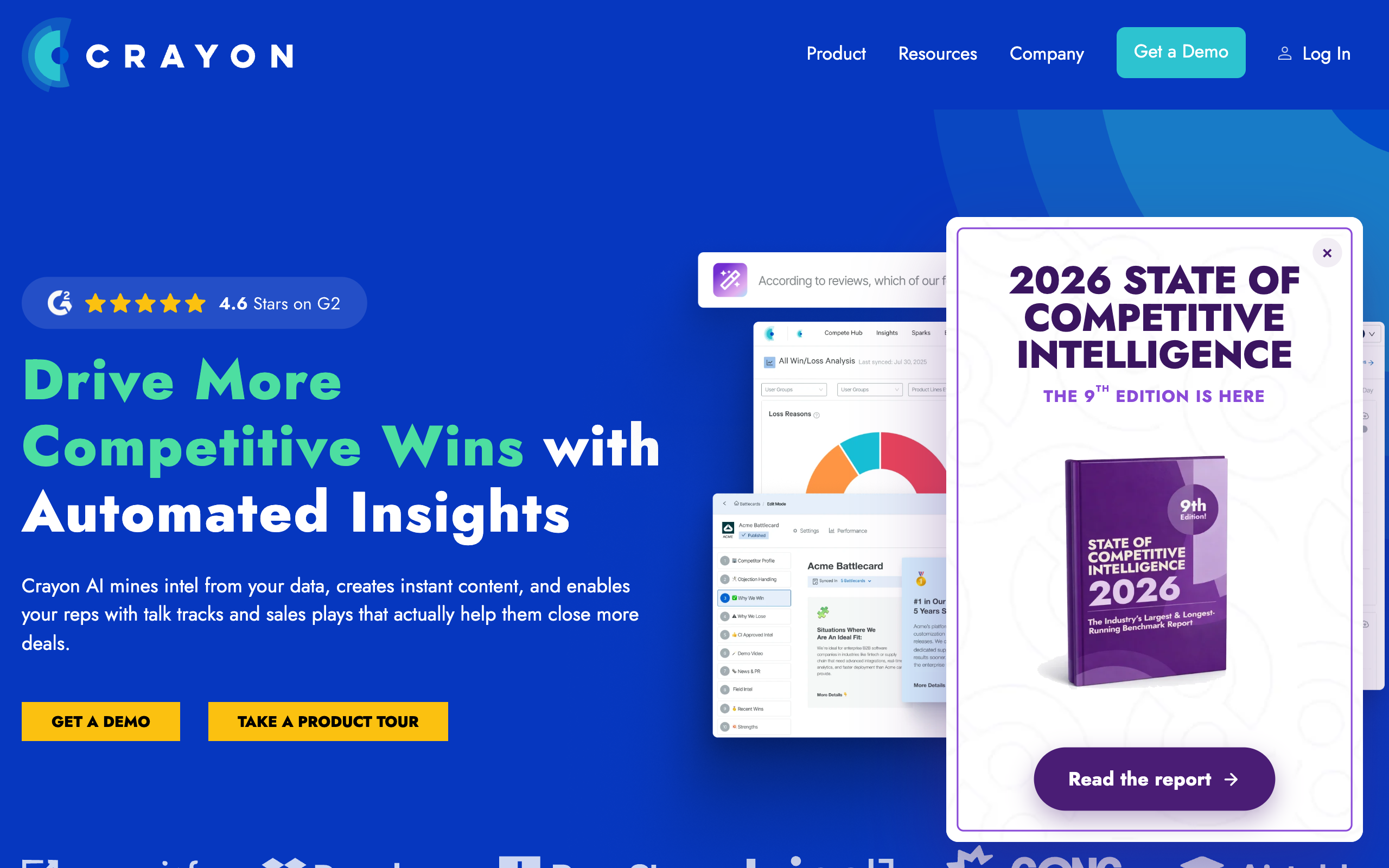
Enterprise CI platforms like Crayon are the serious end: automated capture across dozens of sources, battlecards embedded in the sales org's tools, win/loss analytics, and distribution workflows. For a company with a compete function and sellers who need answers mid-deal, they are the right shape, and their own research (cited above) is some of the best in the field.
The fit stops at scale and shape: pricing is enterprise, and the deliverables (battlecards, enablement) assume a sales org consumes them. An operator who needs "what changed this week and does it matter" is buying a fraction of the product.
Verdict: right for compete teams arming a sales org.
Route 2: page-change watchers
Page-change watchers (Visualping-class tools) do one thing reliably: tell you a URL changed. They are cheap, simple, and honest about their scope. Visualping's own study of 12,000 tracking jobs shows how widely they are used for exactly this.
The scope is also the limit: every alert is unread homework. No watcher knows that the pricing change matters and the footer typo does not, that the changelog entry encroaches on your lane, or that three small changes across three pages add up to a repositioning. Detection without judgment reproduces the original failure with better plumbing.
Verdict: right for cheaply watching a handful of URLs when you will genuinely do the reading.
Route 3: the agent lane
The agent lane treats monitoring as an owned research lane. In MissionControlHQ, the research agent runs it end to end:
- Scheduled sweeps per cadence: built-in scrape tools cover pages, search, and news, with freshness controls so repeat sweeps stay cheap and an explicit credit budget so cost is bounded and visible.
- The judgment pass. The agent compares findings against the previous brief and its memory of your positioning: what changed, whether it matters, and why, in two sentences per item.
- A sourced Monday brief. One document on the board: changes that matter, each linked to its source. Verification takes seconds because every claim carries its URL.
- Escalation for the urgent. A price drop or a launch in your lane becomes an immediate task with an @-mention, not a Monday footnote.
- The ledger. Every sweep is a recorded run with its cost, so "what does monitoring cost us" has a number.
The structural difference from routes 1-2: the same squad runs your other lanes, so the research agent's findings feed the content agent's calendar and the sales conversations without a human ferrying insights between tools.
Verdict: right for operators who want the judgment automated and the strategy call kept human.
What each route costs
With published pricing as of July 2026:
| Route | Typical cost | Judgment included? |
|---|---|---|
| Enterprise CI platform | Tens of thousands $/yr | Yes, via your compete team using it |
| Page-change watchers | $10-100/mo | No: alerts only |
| MissionControlHQ squad | $199-299/mo all-in ($99 + $100-200 AI plan) | Yes: the judgment pass is the point |
One caught pricing move pays the quarter
Meeting competitors in 68% of deals means one missed repositioning costs real revenue. The monitoring lane rides a $199-299/mo squad that also runs content, billing, and support lanes.
How to choose
Who consumes the intelligence?
- If a sales org needing battlecards mid-deal→enterprise CI platform (Crayon-class)
- If you, making weekly decisions→agent lane with a Monday brief
How much reading will you honestly do?
- If I'll read every alert myself→page watchers are the cheap, honest choice
- If I want the so-what written for me→agent lane (judgment pass + sourced brief)
Is monitoring your only automation need?
- If yes, just watching competitors→a point tool is simpler
- If no: content, billing, support lanes too→one squad, monitoring as a lane
Use-case cheat sheet
| Scenario | Best pick | Why |
|---|---|---|
| 50-seller org losing head-to-head deals | Enterprise CI platform | Battlecards in the CRM are exactly their product. |
| Watch 5 competitors' pricing pages, weekly brief | MissionControlHQ agent lane | Sweeps + judgment + sourced brief is the operator shape. |
| Track 3 URLs, read alerts yourself | Page watcher | Cheapest honest tool for pure detection. |
| Competitor is mid-launch, need daily awareness for 3 weeks | Agent lane, daily cadence | Crank the cron, then drop back to weekly; credits keep cost visible. |
| Findings should feed your content calendar | Agent lane | The research agent hands the content agent material on the same board. |
| Board asks for a competitive landscape once a year | Do it manually | Annual work does not justify standing automation. |
Frequently asked questions
Basics
What is the best way to automate competitor monitoring? Match the tool to the stakes. Enterprise competitive-intelligence platforms fit compete teams running battlecards across a sales org. Page-change watchers fit tracking a handful of URLs cheaply. An AI agent lane fits operators who want scheduled sweeps plus a judgment layer that turns raw changes into a short weekly brief with sources.
What should a small business monitor about competitors? Five things cover most decisions: pricing pages, changelogs or release notes, their blog and announcement channel, review-site movement, and hiring pages (which telegraph strategy). Weekly cadence for pricing and news, twice-weekly for changelogs during active seasons.
How often should the sweeps run? Weekly is the honest default for small teams: enough to catch pricing and positioning moves while keeping the brief readable. Daily sweeps make sense only during a competitor's active launch season or your own pricing decision window.
The agent lane
How do AI agents monitor competitors differently from page watchers? Page watchers alert on any pixel change and leave the reading to you. An agent lane does the second pass: it compares the change against history, decides whether it matters, writes the two sentences of why, and links the source. The deliverable is a brief, not a diff.
Can I trust an agent's competitive brief? Trust the structure, verify the claims: a good agent brief links every claim to its source page, so checking takes seconds. In MissionControlHQ the research agent's scrape tools record what was fetched and when, and the brief lands as a document with the runs ledger showing the sweeps behind it.
What does automated competitor monitoring cost? Enterprise CI platforms run tens of thousands per year. Page watchers run $10-100/mo for meaningful URL counts. A MissionControlHQ squad is $199-299/mo all-in ($99 flat + the recommended $100-200 AI plan), with monitoring as one lane among several, and scrape usage bounded by an explicit credit budget.
Sources
- Crayon: State of Competitive Intelligence, homepage
- Competitive Intelligence Alliance: 2025 CI trends
- Visualping: competitor monitoring study
- MissionControlHQ: homepage, early access
- Related on this site: Why MissionControlHQ, Mission Control for OpenClaw
Last updated: July 2026. Pricing and features verified as of July 2026.