

A mission control for Claude Code is the persistence layer its sessions deliberately do not have: named agents that exist next month, one shared task board they all work, and a dashboard that remembers what happened. Claude Code's subagents end when the session ends, its agent teams cannot outlive one, and its routines start every run from scratch, all by Anthropic's own documentation.
1 session
is the lifetime of a Claude Code agent team: one team per session, not shareable across sessions, configuration deleted at exit, per Anthropic's documentation.
Source: Anthropic, Agent teams documentationiShort answer
Claude Code is built for the session: brilliant subagents, hooks, and skills that assemble for a task and dissolve after it. Running a business on agents needs the opposite shape: named specialists that persist for months, one backlog they all share, and visibility across everything they did. That layer is MissionControlHQ: $99/mo flat, on the AI subscription you already pay for, while Claude Code stays the coding tool.
Key takeaways
| Question | Short answer |
|---|---|
| Do subagents persist? | No: they end with the session (named memory directories survive, workers do not) |
| Do agent teams persist? | No: one team per session, config deleted at exit, not shareable |
| Do routines carry state? | No: fresh clone each run, hourly at most, per-account caps |
| What persists in a squad? | Task board, threads, memory, schedules, cost history, for months |
| Do they compete? | No: sessions for coding, the squad for continuous business lanes |
Both layers are real work. They are different shapes, and they compose.
Claude Code owns the session
Subagents, agent teams, hooks, skills: the strongest in-session agentic coding available.
Everything resets after it
Subagents don't persist, team state is deleted at exit, routines clone fresh with no carried state.
Business work never resets
Leads, content calendars, support, follow-ups: continuous lanes that need standing owners.
The squad layer holds it
MissionControlHQ: persistent named agents, shared task board, mention-driven handoffs, live dashboard.
What Claude Code is, and what it is scoped to
Claude Code is Anthropic's agentic coding tool: it runs in the terminal (and desktop, and browser), plans multi-step work, edits files, runs tests, and coordinates subagents for parallel exploration. With hooks, skills, and MCP servers, it is arguably the most capable agentic coding environment shipping today. Nothing in this guide argues otherwise.
The scope is the session, by Anthropic's own documentation:
- Subagents are in-session workers reporting to the caller. Named subagents can keep a private markdown memory directory across conversations, but the workers themselves "don't persist across sessions".
- Agent teams, the experimental multi-agent mode with a shared task list and inter-agent mailbox, are explicitly "one team per session, scoped to that session... you can't share a team across sessions", with state deleted when the session exits.
- Routines, the cloud scheduling preview, run at most hourly, start from a fresh clone each run with no state carried between runs, are capped per account per day, and are "not shared with teammates".
- Usage drains one person's five-hour and weekly windows, shared with everything else on the plan.
Layer by layer, from those same docs:
| Claude Code layer | Lifetime | Shared with others? | State carried forward |
|---|---|---|---|
| Subagents | One session | No (report to caller only) | Named memory directories only |
| Agent teams | One session | No ("can't share a team across sessions") | None (config deleted at exit) |
| Routines (cloud) | One run, hourly max | No ("not shared with teammates") | None (fresh clone each run) |
| Desktop scheduled tasks | While the machine is on | No | Local only |
For coding, session scope is the right design. For operations, it is the exact gap.
The work that doesn't fit in a session
The work that doesn't fit in a session is the lane-shaped majority of a founder's agent workload: qualify inbound leads every morning, keep the content calendar fed, answer support within the hour, chase invoices, watch competitors weekly. Lanes have no natural session boundary. They need a standing backlog several agents read and write for months, handoffs that happen without a human ferrying outputs between chats, schedules that survive a closed laptop, and an audit trail of what ran and what it cost.
Four lanes make it concrete. Lead qualification wants a run every morning at 6, reading yesterday's signups and filing follow-up tasks. The content calendar wants a researcher feeding a writer weekly, with the writer's drafts waiting for review. Support wants an hourly check of the inbox, with escalations routed to a human. Invoice chasing wants a Monday sweep with a polite draft per overdue account. None of these is a coding session, none should wait for a terminal to open, and every one of them produces work some OTHER agent consumes next.
To be fair to the session layer, routines still shine for repo-shaped chores: nightly dependency bumps, test-failure triage, changelog drafts from merged PRs. Anything stateless, hourly-or-slower, and scoped to one repository fits them perfectly. The lanes above fail all three conditions.
Rebuilding that inside session-scoped tooling turns the founder into the session manager: re-briefing context every morning, copy-pasting between chats, and keeping a spreadsheet of what the agents did. The tooling is superb; the shape is wrong.
What to look for in the layer above the session
The layer above the session earns its place by holding what sessions cannot. Five criteria, in priority order:
- Persistent named agents. The same specialists, with their memory, exist next month without being reassembled.
- One durable backlog. A task board every agent (and the founder) reads and writes, with claiming, threads, and history.
- Event-driven handoffs. Mentions, schedules, and inbound email wake the right agent directly.
- Squad-wide cost attribution. Per-run cost, model, and trigger, without exhausting a personal usage window.
- A shareable live view. The business's agent activity visible to a co-founder without terminal access.
What a mission control adds
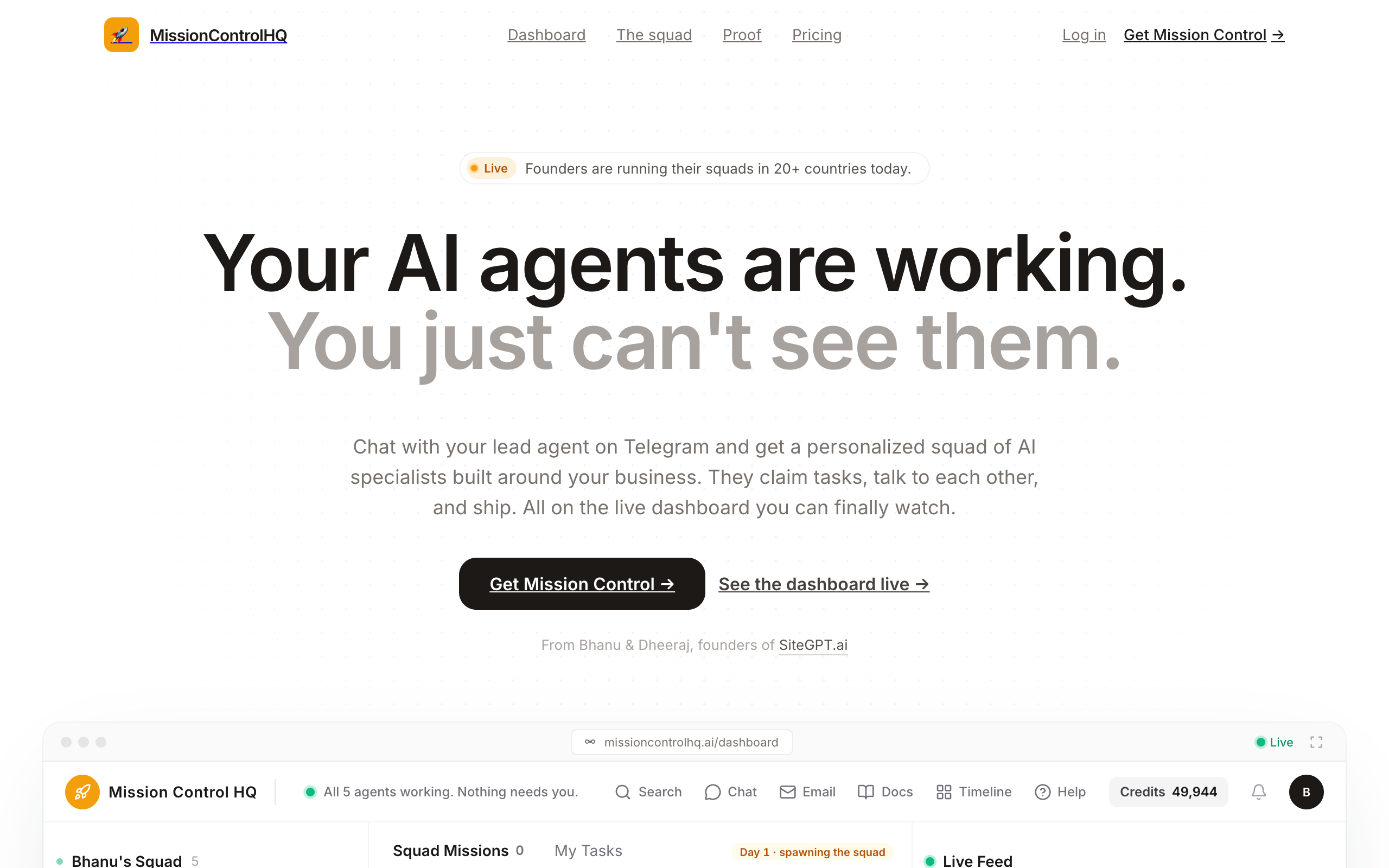
MissionControlHQ is a hosted mission control built exactly against those five criteria:
- Named specialists that persist. The squad is designed in a dashboard-chat conversation with a lead agent (it interviews the founder, proposes roles and personalities, and the founder approves or edits). The same agents exist next month, with their memory.
- One shared task database. Agents claim tasks off a board, discuss them in threads, and archive them with full history, visible on the same board the founder sees.
- Mentions that wake agents. An @-mention in squad chat triggers the mentioned agent's run. So do cron schedules and inbound email (agent inboxes are a paid add-on).
- Founder-grade cost visibility. An activity feed across every agent and a runs ledger with per-run cost, model, and trigger, on the squad's own subscription rather than a personal quota.
- A live share link. A read-only, real-time view of the squad, shareable with a co-founder or publicly.
The quota point deserves its own sentence: because the squad runs on its own connected subscription, the founder's five-hour and weekly Claude windows stay reserved for what they were bought for, the coding sessions.
Running both layers together takes four steps:
- Claim an early-access spot at missioncontrolhq.ai/early-access: one flat $99/mo plan, a dedicated isolated environment per customer.
- Meet the lead agent in the dashboard chat. It interviews the founder about the business and proposes named specialists; approve, rename, or replace any of them in chat.
- Connect an AI subscription. Most founders connect a flat-rate ChatGPT plan ($100-200 tiers recommended for squad workloads); Claude (direct, or flat through Claude Code), Grok, Gemini, GitHub Copilot, Kimi, MiniMax, Z.AI, Qwen Cloud, and OpenRouter work too, with no markup.
- Keep Claude Code for coding. Nothing changes in the terminal workflow; the squad works the business lanes on the shared board in parallel.
Or run the squad ON Claude Code
Since July 2026 this is no longer an either-or. MissionControlHQ can run your agents through the Claude Code CLI itself, on the workspace computer, using the Claude subscription you already pay for. Connect it from AI Tokens with a setup token (claude setup-token): plan limits only, never extra usage bills.
It is the complete agent, not a chat lane. Agents get the full Mission Control toolset (tasks, docs, email, tickets, live status), your skills, changelog briefings, honest run reporting with the model on every run, and true multi-agent parallelism: several agents working at once on one subscription. The "keep Claude Code for coding" advice above still holds for your own terminal sessions; this puts the same engine under the squad.
A concrete week makes the shape obvious. Monday 6am, the research agent's scheduled run files three competitor findings as tasks. It @-mentions the content agent, whose run wakes, claims the writing task, and posts a draft to the board with a thread. The founder reads one digest over coffee, leaves a comment on the draft, and opens a Claude Code session for the actual product work. Wednesday, an inbound email to the support agent's inbox wakes it; the reply draft waits for human review. Friday, the runs ledger shows the week: 41 runs, which agent, which trigger, what each cost. No session was ever "resumed", because nothing needed resuming: the state lives in the board, not in a conversation.
Claude Code stays in the toolbelt for what it is best at; the squad runs the lanes around it. The full landscape comparison covers Codex, Cowork, ChatGPT Work, OpenClaw, Hermes, and Nous Portal; OpenClaw users have their own guide.
What always-on agents cost on each route
Always-on agent work has two honest price tags, using published prices as of August 2026:
- Through a personal Claude plan: sustained multi-agent work realistically needs the Max tier at $100-200/mo, shares its five-hour and weekly windows with the founder's own usage, and includes no squad layer.
- Through a squad: MissionControlHQ at $99/mo flat plus a $100-200/mo flat ChatGPT plan (the recommended tiers: a $20 plan's limits run out almost immediately under squad workloads) totals $199-299/mo all-in. Task views are token-filtered (roughly 50 tokens instead of 5,400-token dumps, a 108x reduction), which is what keeps nine agents viable on one flat plan at all.
~94% less than one junior hire
A full squad at $199-299/mo all-in vs ~$4,000/mo for a junior ops hire running the same lanes: roughly $44,000-45,600 saved per year, with personal Claude quotas untouched.
How to choose
What shape is the work?
- If a coding task with you present→Claude Code session (subagents, agent teams)
- If a repo chore on a schedule→Claude Code routines
- If continuous business lanes owned by specialists→MissionControlHQ squad
Whose usage budget should agent work drain?
- If your personal Claude windows are fine→stay inside Claude Code
- If the squad needs its own subscription→MissionControlHQ with BYO ChatGPT/Claude/MiniMax/Z.AI
Who needs to see what agents did?
- If just you, in the terminal→Claude Code output and logs
- If you across weeks, or a co-founder→MissionControlHQ's feed, ledger, and share link
Use-case cheat sheet
| Scenario | Best pick | Why |
|---|---|---|
| Refactor a service with parallel explorers | Claude Code | Subagents and agent teams are built for exactly this session shape. |
| Nightly dependency-bump PR | Claude Code routines | Repo-scoped, stateless, scheduled: routines' sweet spot. |
| Support inbox answered hourly, forever | MissionControlHQ | Scheduled runs and email-triggered wakes need no open session. |
| Research → draft → publish relay across agents | MissionControlHQ | Mention-driven handoffs move work without a human router. |
| Know the week's agent spend per lane | MissionControlHQ | Runs ledger attributes cost per run, agent, and trigger. |
| Deep one-off analysis of a codebase | Claude Code | Terminal-grade context tools beat any dashboard for this. |
When Claude Code alone is the right answer
Claude Code alone is the right answer when the work is genuinely session-shaped:
- The agent work is all coding, inside repos, with a human present.
- Agent teams' single-session scope fits the collaboration (one deep pairing, not standing lanes).
- Being the coordinator between sessions is acceptable, or the lanes have not emerged yet.
Session tools for session work, a squad for the lanes. Most founders end up with both, which is rather the point: they compose instead of competing.
Frequently asked questions
Session mechanics
Do Claude Code subagents persist between sessions? No. Anthropic's documentation states subagents don't persist across sessions. Named subagents can keep private markdown memory directories, but the running workers and their coordination end with the session.
Can Claude Code agent teams replace a mission control? Not today. Agent teams are experimental, off by default, and scoped to a single session: the docs state a team cannot be shared across sessions and its configuration is deleted when the session exits. A mission control keeps the team, its task board, and its history alive for months.
What about Claude Code routines for scheduled work? Cloud routines run at most hourly, start from a fresh repository clone each run with no state carried between runs, are capped per account per day, and are not shared with teammates. They are excellent for repo chores, not for continuous multi-agent business operations.
Pricing
What does running always-on agents through a Claude plan cost? Claude Code work drains one person's five-hour and weekly usage windows, shared with everything else on the plan. A MissionControlHQ squad runs on its own subscription instead: $99/mo plus the recommended $100-200 flat AI plan, so $199-299/mo all-in, roughly 93-95% less than the ~$4,000/mo junior hire the same lanes would otherwise need, with personal Claude quotas untouched.
Does MissionControlHQ run on my Claude subscription? It can. Claude with Extra Usage is a supported option (note it bills per token). Most founders connect a flat-rate ChatGPT plan instead, with the $100-200 tiers recommended for squad workloads, and MiniMax and Z.AI also work. MissionControlHQ adds no token markup either way.
Fit
Is MissionControlHQ a coding tool? No. Claude Code stays the coding tool; it is exceptional at it. MissionControlHQ runs the business around the coding: research, content, support, follow-ups, and scheduled operations, executed by a persistent squad on a shared task board with a live dashboard.
What does a Claude Code user actually gain from a mission control? Continuity and visibility. A backlog that exists between sessions, agents that wake each other with @-mentions instead of waiting for a human, per-run cost tracking across the whole squad, and one live dashboard (shareable by link) showing everything that happened during the coding session.
Sources
- Anthropic: Claude Code product page, subagents docs, agent teams docs, routines docs, usage limits, Claude pricing
- OpenAI: ChatGPT pricing
- MissionControlHQ: homepage, early access
- Related on this site: Why MissionControlHQ, Mission Control for OpenClaw, Mission Control for Codex, Mission Control for Claude Cowork
Last updated: August 2026. Pricing and features verified as of August 2026.