

Hermes Agent gets the coordination problem more right than any other open-source runtime: its Kanban is a real multi-agent task board with named profiles and @-mention routing. A mission control in the hosted sense adds what Kanban's own docs place out of scope: multi-tenancy, cost tracking, a shareable live view, and operations someone else runs.
~99k
GitHub stars in its first 8 weeks made Hermes Agent the fastest-growing open-source agent framework of 2026. The runtime race is real; the operations layer is still the open question.
Source: Dealroom, Hermes Agent milestoneiShort answer
Hermes Agent is a superb self-hosted runtime: persistent memory, self-written skills, a multi-platform gateway, and Kanban, a genuinely good native task board for multiple agents. Its docs are honest about the ceiling: deliberately single-host, local SQLite, cost tracking out of scope, no multi-tenancy. If you are a technical operator on one box, Hermes alone may be everything you need. If you want named specialists running business lanes unattended with costs, approvals, and a live share link, that hosted layer is MissionControlHQ at $99/mo flat plus the flat-rate AI plan the squad runs on.
Key takeaways
| Question | Short answer |
|---|---|
| Is Hermes Kanban a real multi-agent board? | Yes: named profiles, @-mention routing, activity feed. The best native analog in open source |
| What is its designed ceiling? | Deliberately single-host, local SQLite, workers on one machine, cost tracking out of scope |
| Does Nous Portal add coordination? | No: it is credit-metered model/tool ACCESS for one agent |
| What does self-hosting really cost? | $5-80/mo (VPS + watched API spend) plus your time as the operator |
| When does hosted win? | Multi-tenant state, per-run costs, live share links, managed ops: $199-299/mo all-in |
Kanban and a hosted mission control agree on the shape of the problem and disagree on who runs the machine.
Hermes gets coordination right
Kanban: named agent profiles, mention routing, comment threads, an append-only activity feed. Real squad mechanics.
And scopes it to one box
Local SQLite, same-machine workers, no cost tracking, no sharing, no multi-tenancy, all by explicit design.
A business needs the rest
Costs per run, a share link for a co-founder, state that outlives the box, and ops someone else owns.
That is the hosted layer
MissionControlHQ: cloud squad state, runs ledger, live share, managed isolated environments per customer.
What Hermes Agent gets right
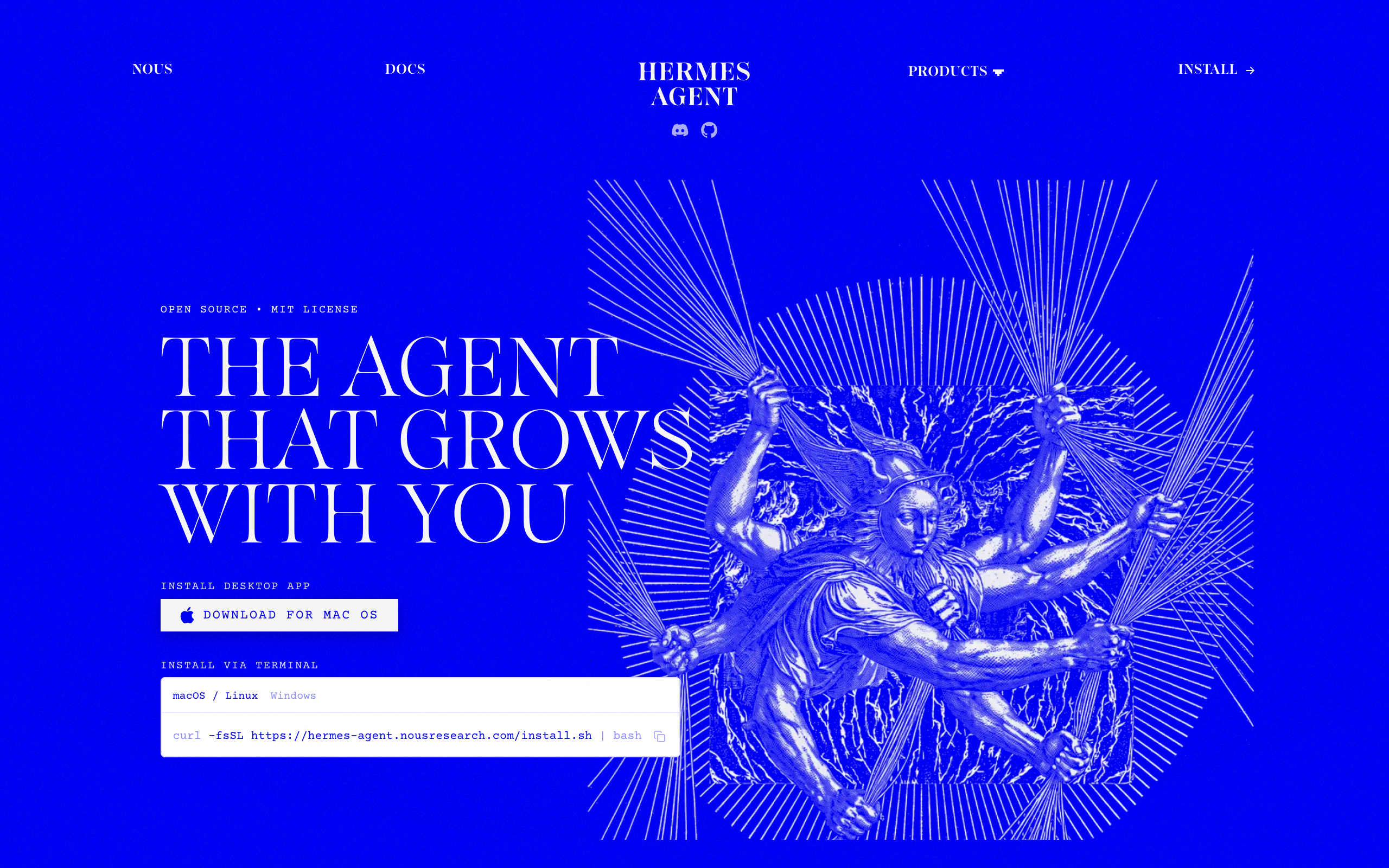
Hermes Agent is Nous Research's open-source, MIT-licensed agent runtime, launched February 2026: persistent memory, skills the agent writes for itself when it solves a hard problem, orchestrator-worker subagents (since v0.6.0), and a gateway spanning Telegram, Discord, Slack, WhatsApp, Signal, email, and CLI.
Two things deserve straight credit. First, the growth is real: roughly 99,000 GitHub stars in eight weeks. Second, and more relevant here: Hermes Kanban is a genuine multi-agent task queue: named agent profiles, @-mention routing between agents, comment threads on tasks, and an append-only activity feed. That is squad mechanics, native, in open source. No other runtime on this site's landscape comparison ships anything as close.
Where Hermes' own docs draw the line
The same documentation that describes Kanban also states its ceiling, plainly and on purpose:
- "Deliberately single-host." The board is a local SQLite file; workers spawn on the same machine. The squad lives and dies with one box.
- Cost tracking is explicitly out of scope. Which agent spent what, on which task, at which model: not Kanban's job.
- No sharing, no multi-tenancy. There is no link to hand a co-founder, no per-client separation, no view that exists off the operator's machine.
- Profiles are not sandboxes. The docs say so directly: two profiles can hold separate memory while still sharing the operator's full disk on the local backend. Real isolation is available and arrives as Docker containers you configure yourself.
- Self-hosting is the deal. Realistic budgets run $5-80/mo: a $4-25 VPS plus metered LLM API spend that "needs active cost babysitting," with updates, security, and uptime owned by the operator.
None of this is a flaw. It is a design choice for a specific person: a technical operator who wants full ownership on hardware they control. The honest question is whether that person is you.
What Nous Portal does and doesn't solve
Nous Portal (launched April 2026) is one subscription replacing the pile of API keys a Hermes agent otherwise needs: 300+ models plus a managed tool gateway (search, scraping, image generation, browser, code execution), metered in credits from $20 to $200/mo tiers.
Portal solves ACCESS, and solves it well. Its integration docs frame it entirely as "one OAuth login replaces separate accounts, API keys, and billing." What it does not add, anywhere in its documentation: multi-agent coordination, shared task state beyond the single host, cost attribution per agent or task, or any business dashboard. Portal makes one Hermes agent easier to fuel; it does not make nine of them a team.
What to look for beyond the single-host ceiling
A coordination layer for a business, whatever runtime powers it, should pass six tests. Kanban passes the first half of several; the ceiling shows in the second half:
- State that outlives any one machine. The board, threads, and memory survive a dead VPS, a migration, a stolen laptop.
- Coordination as wake signals. Mentions, schedules, and inbound email trigger the target agent's run directly. (Kanban's mention routing does this on-box; nothing wakes across machines.)
- Cost attribution built in. Per-run cost, model, and trigger, per agent, per week, without a spreadsheet.
- Boundaries between agents that you did not have to build. Each connection carries a permission level applied per agent, so the same account can be read-only for one and full for another, and blocked actions surface in the activity feed instead of failing quietly. This is the Boundary Test, and it is the test a shared disk fails from one direction and a shared cloud computer fails from the other.
- A shareable live view. A co-founder, a client, or the public can watch without SSH.
- Operations someone else owns. Isolation, updates, restarts, and support with a named responsible party.
The hosted squad route
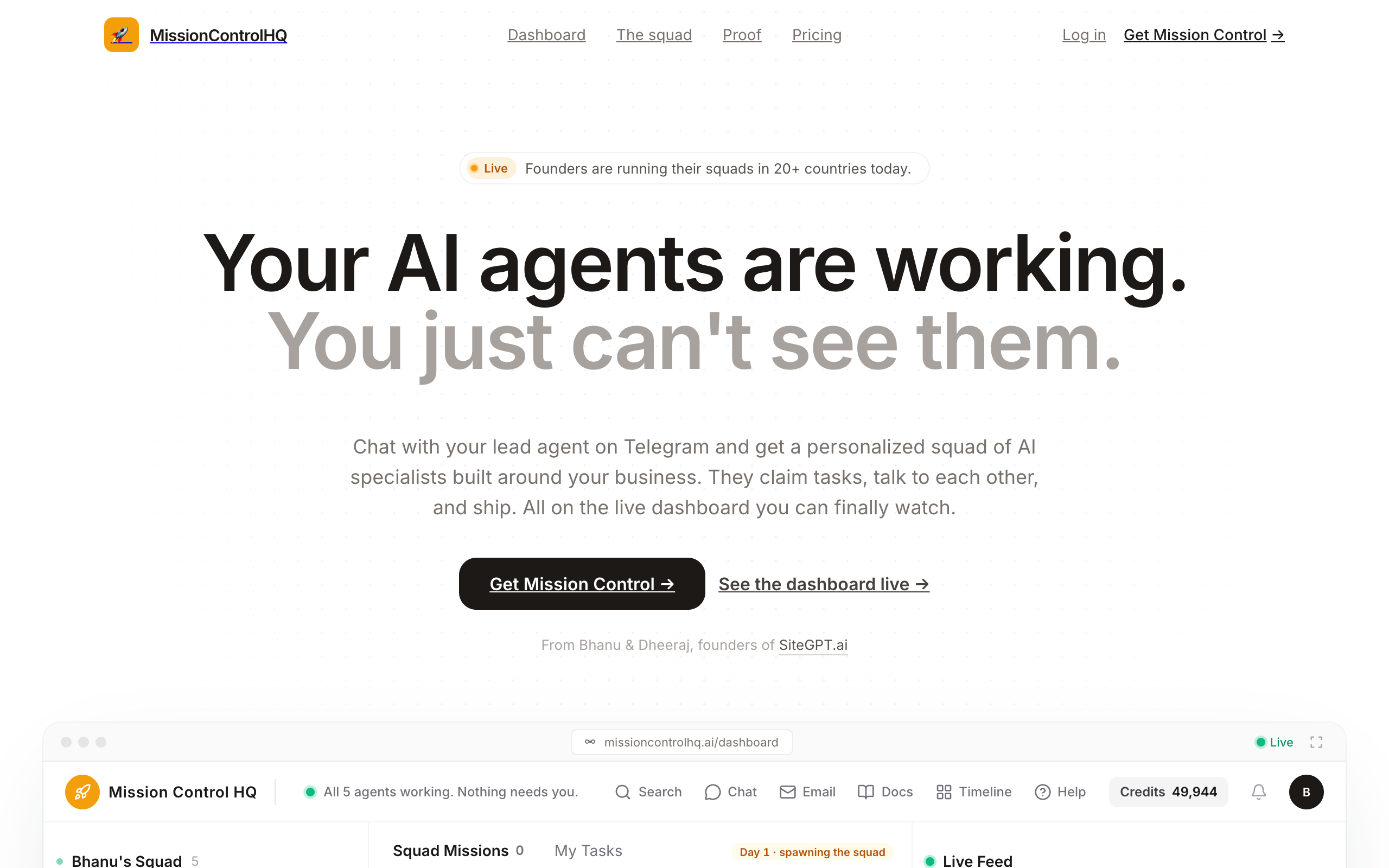
MissionControlHQ is the hosted, multi-tenant version of the idea Kanban proves on one box:
- Cloud squad state: one task database every agent reads and writes, with threads, claiming, and full history, surviving any single machine.
- Mentions that wake agents: an @-mention in squad chat triggers the mentioned agent's run; so do cron schedules and inbound email (agent inboxes are a paid add-on).
- The runs ledger: per-run cost, model, and trigger, per agent, exactly the tracking Kanban scopes out.
- A live share link: a read-only, real-time view of the squad for a co-founder or the public (the owner controls search indexability).
- Managed isolation: each customer's squad runs in its own dedicated cloud environment with health checks and support. No VPS, no update roulette, no "active cost babysitting."
- Per-agent permission levels: every connection is set to read-only, read and write, or full, changeable per agent without re-authorization, with multiple accounts per app. Skills stay squad-wide, so the wall runs through connections rather than instructions.
- Squad design by interview: a lead agent greets the founder in the dashboard chat, learns the business, and proposes named specialists the founder approves or edits. Setup is about ten minutes.
There is also a philosophical difference worth naming honestly. Hermes culture favors channels and one highly capable agent the operator drives conversation by conversation. MissionControlHQ favors named specialists working lanes unattended, with approval gates and a digest. Neither is wrong: the first optimizes for control, the second for delegation. Pick by how much driving you want to do; the Claude Code guide makes the same sync-vs-async distinction for coding tools.
What each route costs
With published prices as of August 2026, pre-calculated:
| Route | Monthly | What it includes | What stays yours to do |
|---|---|---|---|
| Hermes self-hosted | $5-80 | Runtime, Kanban, full ownership | Server, security, updates, cost watching, everything off-box |
| Hermes + Nous Portal | $25-280 | Above + one login for models/tools (credits) | Same operations; coordination still single-host |
| MissionControlHQ | $199-299 all-in | Hosted squad, board, wakes, runs ledger, share link, managed isolation ($99 + a $100-200 flat AI plan) | Approving the work |
~94% less than one junior hire
A hosted squad at $199-299/mo all-in vs ~$4,000/mo for a single junior ops hire running the same continuous lanes: roughly $44,000-45,600 saved per year.
The recommended AI plan is the $100-200 flat tier (a $20 plan's limits run out almost immediately under squad workloads); MissionControlHQ adds no token markup on top.
How to choose
Who should run the machine?
- If you, deliberately (ownership is the point)→Hermes self-hosted, Kanban enabled
- If nobody (the business is the point)→MissionControlHQ
How many humans need to see the board?
- If just you, on your box→Hermes Kanban is genuinely enough
- If a co-founder, an operator, or clients→MissionControlHQ's live share link
Does cost attribution matter?
- If no, API bills are fine as one number→Hermes (+ Portal for one login)
- If yes, per agent and per lane→MissionControlHQ's runs ledger
Use-case cheat sheet
| Scenario | Best pick | Why |
|---|---|---|
| Technical operator, one box, full control | Hermes + Kanban | The best native single-host squad mechanics in open source. |
| One login instead of six API keys for that box | Nous Portal | Access is exactly what it sells; know it adds no coordination. |
| Non-technical founder who wants lanes run FOR them | MissionControlHQ | Squad designed by interview; zero server administration. |
| Show a co-founder or client the agents working | MissionControlHQ | Live share link; Kanban has no off-box view by design. |
| Know what each agent spent this month | MissionControlHQ | Per-run cost attribution; Kanban scopes cost tracking out. |
| Channel-driven work with one capable agent you steer | Hermes | That philosophy is Hermes' home turf; a squad board would fight it. |
When Hermes alone is the right answer
Hermes alone is the right answer when the single-host ceiling is not a ceiling for you:
- You are technical, enjoy running infrastructure, and ownership is a feature.
- One operator on one box is the whole team; nobody else needs the view.
- Channel-driven, operator-steered work fits how you think better than delegated lanes.
- Self-hosting is a requirement, not a preference. (MissionControlHQ self-hosting is on the roadmap, not available today; compliance-sensitive founders should email bhanu@missioncontrolhq.ai first.)
The hosted squad earns its keep the day the box needs to outlive the operator's attention: multiple lanes, visible costs, a shareable view, and ops that are somebody else's job.
Frequently asked questions
Hermes mechanics
Does Hermes Agent have a task board for multiple agents? Yes. Hermes Kanban is a real multi-agent task queue: named profiles, @-mention routing between agents, comment threads, and an append-only activity feed. It is the closest native analog to a squad in open source.
What are Hermes Kanban's limits? Its own documentation states them plainly: Kanban is deliberately single-host, stored in a local SQLite file, with workers spawned on the same machine. Cost tracking is explicitly out of scope, and there is no sharing or multi-tenancy.
Does Nous Portal turn Hermes into a hosted squad? No. Nous Portal is one credit-metered subscription for 300+ models and managed tools (search, browser, code execution) for a Hermes agent. It solves model and tool ACCESS for one agent; it does not add multi-agent coordination, task boards, or business dashboards.
Costs and fit
What does self-hosting Hermes actually cost? Realistic self-host budgets run $5-80/mo (a $4-25 VPS plus metered LLM API spend that needs active watching), and the operator owns updates, security, and uptime. Portal tiers run $20-200/mo in credits on top if used.
How is MissionControlHQ different from Hermes Kanban? Same idea, opposite deployment philosophy. Kanban is a free, local, single-operator power tool. MissionControlHQ is hosted and multi-tenant: squad state lives in the cloud, every run carries cost attribution, the dashboard has a live share link, and each customer gets a managed isolated environment, for $99/mo flat plus the flat-rate AI plan the squad runs on.
What does the hosted squad cost all-in? MissionControlHQ is $99/mo flat plus the recommended $100-200 flat AI plan, so $199-299/mo all-in, with no token markup and no per-agent seats. The honest comparison is the ~$4,000/mo junior hire the same continuous lanes would otherwise need: roughly 93-95% less.
I love Hermes' channel-based way of working. Is a squad board better? They are different philosophies, both valid. Channels with one capable agent suit a technical operator who wants to drive each conversation. A squad on a shared board suits an owner who wants named specialists working lanes unattended, with approvals and a digest. Pick by how much driving you want to do.
Sources
- Nous Research: Hermes Agent, Kanban docs, Nous Portal, Portal integration docs
- Ecosystem: Hermes star growth, self-host cost analysis
- MissionControlHQ: homepage, early access
- Related on this site: Why MissionControlHQ, Mission Control for OpenClaw, Mission Control for Claude Code, Grok Bot alternatives and the Boundary Test
Last updated: August 2026. Pricing and features verified as of August 2026.