

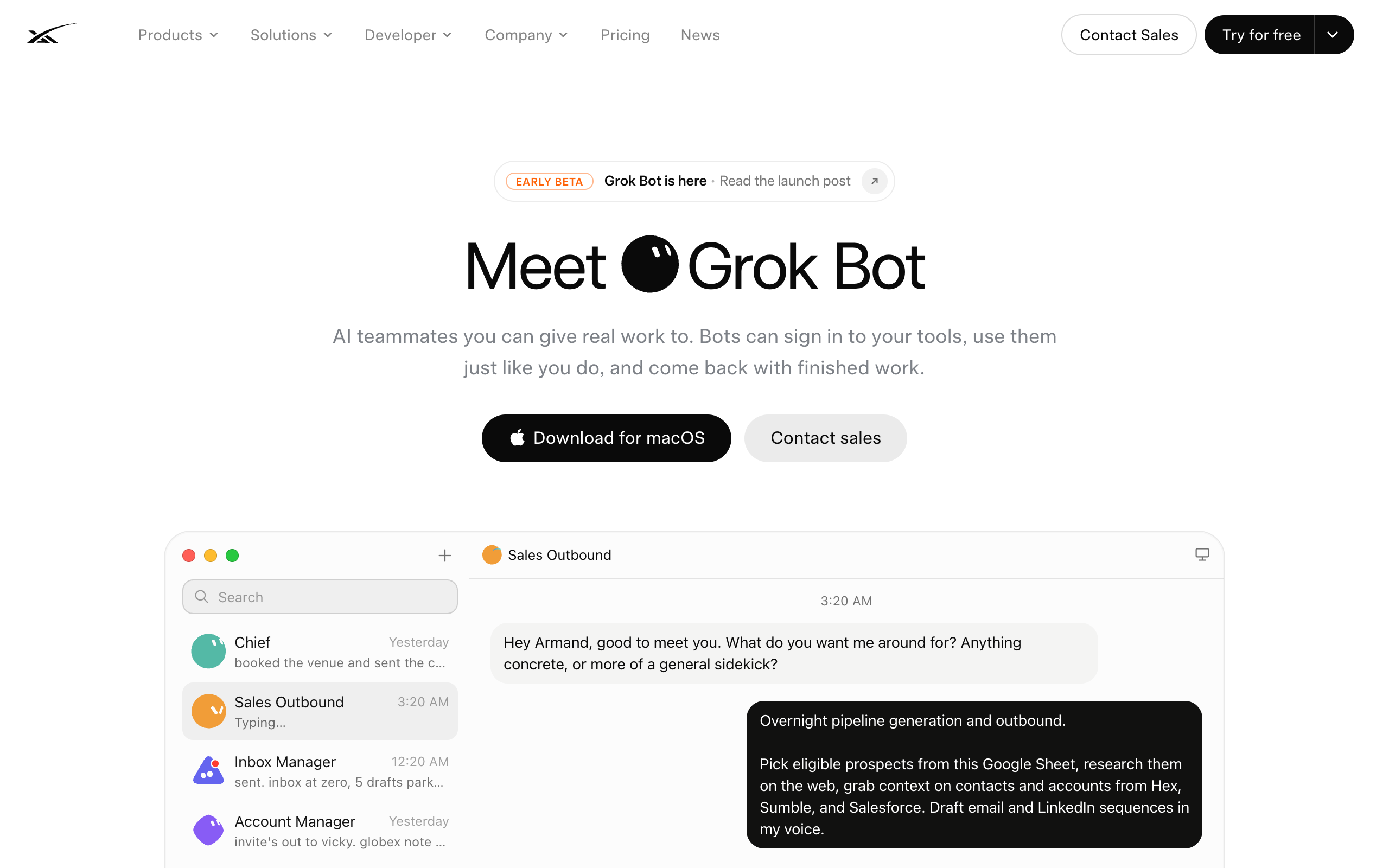
On 11 August 2026, xAI shipped Grok Bot into early beta with a product page that reads like an org chart. Sales Outbound. Talent Scout. Account Health. Chief of Staff. Named teammates that sign into your tools, work through the night with your laptop closed, and pass work to each other in a shared thread.
A year ago that setup meant a Mac Mini on a shelf and a weekend of YAML. The interesting part of the launch is not the product. It is that a company which never has to explain itself decided this shape was ready for consumers.
Then read xAI's own FAQ. Under "Do Bots share one computer?" the answer is yes: "Every Grok Bot shares one persistent cloud computer. Your Bots share that machine (files, browser, logins), so they can hand work off and keep context. Isolation is per user, not per Grok Bot."
That sentence is the whole brief for every Grok Bot alternative. Running one agent got easy. Running a team of them, with real walls between them, did not.
57%
of organizations now deploy AI agents for multi-stage workflows, and 16% have progressed to cross-functional processes spanning multiple teams. The work moved past one agent answering one prompt before the tools did.
Source: Anthropic, The 2026 State of AI Agents Report (500+ technical leaders, with Material)iShort answer
Grok Bot is the clearest proof yet that founders want a squad, meaning a coordinated set of specialist AI agents rather than one generalist wearing five hats. It is also honest in its own documentation about the trade: every bot shares one persistent cloud computer, isolation is per user rather than per bot, and the model is xAI's. That leaves one job for any alternative, which is running several agents with real boundaries between them on a model you chose. Call it the Boundary Test. None of this is settled: Grok Bot is weeks old and in early beta with gaps its own users list, so the useful move today is keeping your options portable rather than picking a winner. MissionControlHQ answers it at $99/mo flat as of August 2026, on your own AI subscription with no token markup, against $200 to $300/mo for Grok Bot.
Key takeaways
| The question | The answer |
|---|---|
| The Boundary Test, as a check | Can this setup structurally stop agent A from touching what agent B touches? Not by instruction, by architecture. Grok Bot's own FAQ states isolation is per user, not per bot |
| Where the category actually is | Opening, not settled. Grok Bot shipped in early beta in August 2026 with gaps its users name openly, and the open runtimes rotate free frontier models every few weeks |
| What Grok Bot genuinely nails | Zero setup, one sign-in that every bot inherits, agent-to-agent handoff, and work that continues with the laptop closed |
| What Grok Bot costs | $200/mo with Cursor Ultra or $300/mo with SuperGrok Heavy, both billed monthly, or $120/seat/mo on Premium Teams. Free tier to start |
| The lock nobody mentions in the demos | The model is not yours to pick. The subscription bundles the runtime, the machine, and the intelligence into one vendor |
| Where open source lands | Hermes Agent is free, MIT, and at 232.7k GitHub stars, and its own docs say profiles do not sandbox the agent. Same wall, opposite direction |
| When Grok Bot alone is enough | One operator, one business, every account already shared. A shared machine is accurate then, not risky |
Three existing tests decide whether work gets its own agent. This one asks whether the platform can hold the agents those tests produced.
The question
Can this setup structurally prevent agent A from reaching what agent B reaches? Files, logins, connected accounts, memory.
Why instructions do not count
Telling an agent to stay out of a folder is a request. A permission it cannot exceed is a boundary. Only the second survives a bad run.
Where closed platforms fail it
Grok Bot's own FAQ: one persistent cloud computer, shared files, browser, and logins, isolation per user rather than per bot.
Where open runtimes fail it
Hermes Agent's own documentation: profiles do not sandbox the agent. Separate memory, same disk, unless you build the containers yourself.
What Grok Bot actually ships
Grok Bot gives you named AI teammates that operate a cloud computer, sign into your tools through a real browser, and keep working when your laptop is closed. xAI's framing is deliberate: "AI teammates you can give real work to. Bots can sign in to your tools, use them just like you do, and come back with finished work."
11 Aug 2026
Launched, in early beta
$200/mo
Entry price, bundled with Cursor Ultra
1
Cloud computer, shared by every bot on the account
xAI only
Models available to a bot
24/7
Bots keep running with your laptop closed
macOS, iOS
Where you talk to your bots
Four things in it are genuinely well built, and any honest Grok Bot alternative has to match them rather than pretend they do not matter.
Setup is close to nothing. There is no server to rent, no runtime to update, no gateway to keep alive. The product page's own comparison point is the laptop: bots "run in parallel, 24/7, even when your laptop is closed."
One sign-in covers every bot. Because the machine is shared, authorizing an account once in one conversation makes it available to every other bot. This is the single largest source of friction in agent onboarding, and Grok Bot removes it almost entirely.
Bots teach each other and learn by demonstration. You can ask a bot to watch you complete a workflow once, and it saves the result as a routine it runs on its own afterwards. xAI's line is "Show one a workflow today, hand off the project by Friday."
Agents talk to each other in the open. Put several bots in one thread and they pass work between themselves, with the human watching rather than approving each hop. One reviewer with a 300,000-subscriber channel described running a dozen bots at once, with a chief of staff coordinating the rest.
That last pattern matters for a reason that has nothing to do with xAI. It is the same shape founders keep rebuilding by hand.
Why this launch matters more than the product
The launch matters because it settles an argument about whether ordinary businesses want a team of agents, and the answer turned out to be yes. When a company this size ships named roles, a chief of staff, and agent-to-agent handoff as a consumer product, the category stops needing a defense.
Reviewers reached for org-chart language without being prompted. One reviewer described Grok Bot as "a small company contained inside one application," where "every row in the sidebar is a named teammate with a continuing role." A commenter wrote: "It starts to feel less like using AI and more like managing a team."
They used those words because the product works that way. Named roles, standing responsibilities, and work handed between agents are the shape of an org chart.
Each step removed a barrier and left the next one standing. The current step removed setup. It did not remove the boundary problem.
The DIY era
A spare machine, a runtime you configured yourself, and a weekend. Powerful, and gated behind being technical enough to keep it alive.
The open runtime era
Free frameworks with skills, memory, and schedules. Setup dropped from a weekend to an evening, and the operator was still you.
The consumer era
Grok Bot removes setup entirely: no server, no updates, no uptime. Named roles and agent-to-agent handoff arrive as defaults.
What is still unsolved
Boundaries between agents, a model you chose, and per-agent cost visibility. None of the three arrived with the packaging.
Grok Bot is not finished, and its own users say so. Automation triggers are limited: the routine trigger list covers Slack, Git, Teams, Linear, Sentry, and PagerDuty, but not email. One reviewer reported that agents in a group thread could not save routines and had to have them created by hand. His conclusion was "I'm sure this is going to be something that should be improved over time."
Every product in this category is weeks old, including the ones that look settled.
A category this young does not reward picking the winner early. It rewards keeping the expensive parts portable: the model you pay for, the skills you write, and the instructions your agents run on.
The Boundary Test: what breaks at the second agent
What breaks at the second agent is separation, because almost nothing in this category isolates agents from each other by default. It is easy to give one agent a job. It is hard to give two agents different jobs and guarantee that the first cannot reach what the second is holding.
xAI documents its position on this plainly, which deserves credit rather than criticism. From the official FAQ: "Every Grok Bot shares one persistent cloud computer. Your Bots share that machine (files, browser, logins), so they can hand work off and keep context. Isolation is per user, not per Grok Bot."
That is a considered design choice, not an oversight. The shared machine is precisely what makes the handoff feel effortless, and one reviewer argued the single machine is a security advantage because it keeps the whole system to one perimeter rather than scattering agents across many.
For one person running one business, that reasoning holds. It stops holding the moment two things in your life should not see each other.
Here is that moment, from an agency owner in the comments of a Grok Bot walkthrough:
Skills and plugins are shared across every bot, is there any way to scope them to one bot? Running an agency with 36 clients, and I need bot A to be structurally unable to touch client B's accounts.
Note the word "structurally." He is not asking whether he can instruct a bot to behave. He is asking whether the platform can stop it, which is a different question and the only one that survives a bad run.
Now the same wall from the opposite direction. A founder running two named agents on Hermes Agent, the leading open-source runtime, hit this in the comments of a setup tutorial:
How do you connect different Telegram bots to different Hermes profiles, one bot for Janet and one for Paddy? When I change the Telegram bot token in one profile, it seems to update across all profiles.
Hermes documents its own version of the limit. Its documentation states that profiles do not sandbox the agent, so two profiles can hold separate memory while still sharing the operator's full disk on the local backend. Real isolation is available, but it arrives as Docker containers you configure yourself.
Both shapes are legitimate. They serve different numbers of people, and the wrong one shows up as a security problem rather than a preference.
One machine, many agents
- One sign-in flows to every agent automatically
- Handoff is effortless because context is genuinely shared
- Files, browser, and logins are common ground
- A boundary between two agents is an instruction, not a wall
- Correct when one person owns all of the work
Per-agent boundaries
- Each connection carries a permission level per agent
- Handoff happens on a shared board rather than a shared disk
- The same account can be read-only for one agent, full for another
- Blocked actions surface in the activity feed instead of failing quietly
- Correct when clients, entities, or risk levels must stay apart
So call the check by name. The Boundary Test: can this setup structurally stop agent A from touching what agent B touches? Not by instruction, by architecture.
It is deliberately not a fourth test for splitting work, because three of those already exist on this site and they compose cleanly. The Lane Test asks whether an agent would have to switch context to do the work well, the Rulebook Test asks whether the rule that makes one lane good makes another worse, and the Fetch Test asks whether an output is fully determined by data that already exists.
Those three decide whether work gets its own agent. The Boundary Test asks a different question entirely: whether the platform you picked can actually hold the agents those tests just produced.
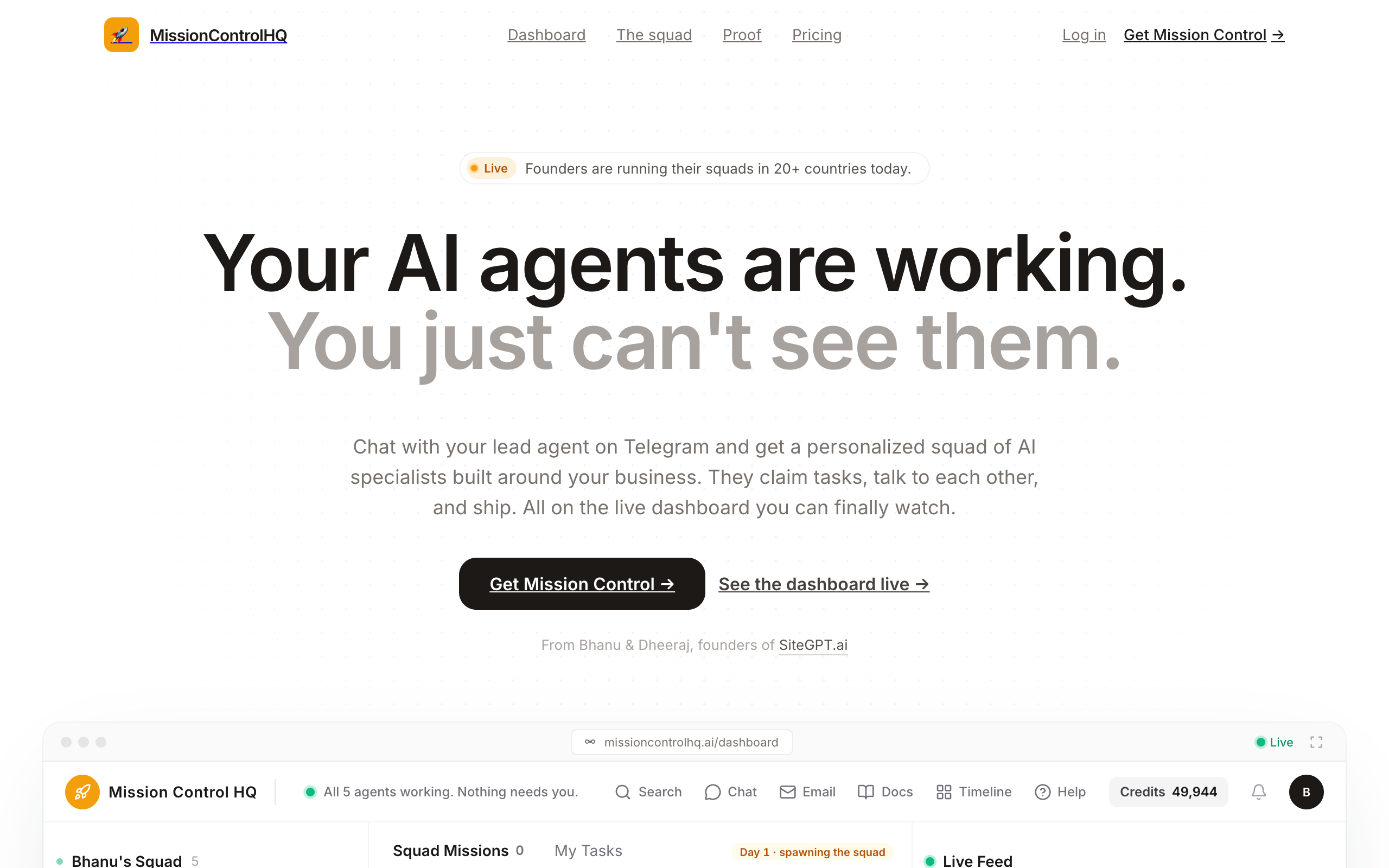
If you already know your answer is "it cannot," that is the gap MissionControlHQ was built for: every connection carries a permission level set per agent, and each customer's squad runs in its own isolated environment rather than sharing one machine.
What $200 a month buys, and what it locks
Grok Bot costs $200 a month bundled with Cursor Ultra, or $300 a month with SuperGrok Heavy, both billed monthly, with a free tier to start. Cursor Premium Teams runs $120 per seat per month and adds centralized billing, a shared marketplace for skills and plugins, usage analytics, and SSO. If you already pay for Cursor Ultra or SuperGrok Heavy, Grok Bot is included at no extra cost.
| Grok Bot | MissionControlHQ | |
|---|---|---|
| Entry price | $200/mo (Cursor Ultra) or $300/mo (SuperGrok Heavy) | $99/mo flat, one plan |
| Model cost | Included, xAI models only | Your own subscription, recommended $100-200 tier, no markup |
| Typical all in | $200-300/mo | $199-299/mo |
| Who picks the model | The vendor | You, across 11 providers, with per-agent overrides |
| Machine | One shared cloud computer, isolation per user | A dedicated isolated environment per customer |
| Per-agent access limits | Not documented | Read-only, read and write, or full, set per agent |
| Cost attribution | Not surfaced per agent | Per-run model and token reporting, runs ledger |
The two split bars are MissionControlHQ at $99 a month flat, plus whichever AI subscription you bring at the recommended $100 or $200 tier. The three single bars are xAI's list prices with the model bundled in, which is the whole difference in one picture.
Price is not the interesting part of that chart, because every bar lands within about a hundred dollars of the next one. The interesting part is the row about who picks the model.
A creator who already runs three other agent platforms daily put the trade in one paragraph:
You do not own the harness. You do not pick the model. The data does live on their cloud PC. This is the tax you stop paying on the open stack.
He also concluded that Grok Bot had "earned a seat" in his workflows anyway, which is the honest version of this. A bundled model is a real convenience and a real dependency at the same time.
The dependency has a cost that shows up later rather than at signup. Model quality moves monthly, pricing moves monthly, and the agent you built around one vendor's model is the agent you cannot move when a better or cheaper one appears. One Grok Bot user had already found the other end of it: "i love GROK bot but i have 20 agents, unless they allow me to import Hermes agents, I'm not REBUILDING everything."
Price is the most common objection in the comments. The reviewer whose walkthrough drew 82,000 views raised it in his own pinned comment: "It's expensive to try. You need Cursor Ultra or Grok ultra plan ($200) min to access. I would probably wait for a cheaper plan unless you're dying to try."
Other users disagreed. One commenter, a self-described architect and coder, called $200 "completely justified" after one morning of use.
The open route, and what it actually asks of you
The open route gives the model choice back and charges for it in operations rather than dollars. Hermes Agent, the open-source runtime from Nous Research, is MIT-licensed, free to run, and sitting at 232.7k GitHub stars as of August 2026, which makes it the most obvious Grok Bot alternative for anyone whose main objection is the locked model.
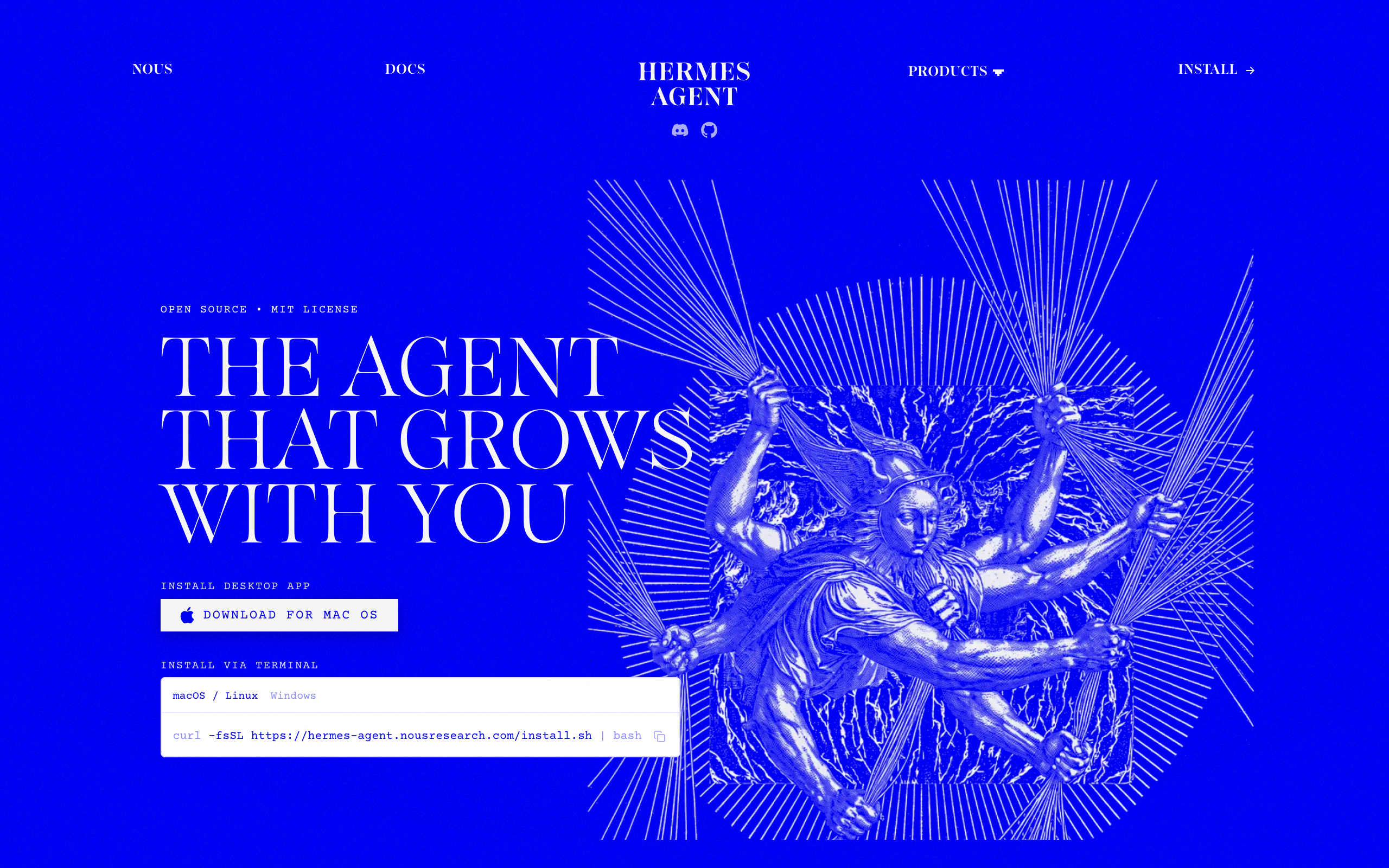
Credit where it is earned. Hermes loads only the names and descriptions of its skills up front, at roughly 3,000 tokens regardless of how many skills exist, and pulls the full content only when a skill is actually needed. It writes new skills from completed work, so repeat tasks get faster. Its skills follow the cross-vendor SKILL.md standard, which means a skill written for one tool runs in another without modification.
That last point is the most underrated fact in this whole category, and it should shape how you think about switching. Portable skills mean the thing you build is increasingly not locked to the runtime you built it on.
The costs are real and mostly not financial. You own hosting, updates, uptime, and security, and the agent stops when your machine does.
An engineer who deployed Hermes on Google Cloud and read its source published the sharpest available critique, and it is worth passing on with his name attached rather than as received wisdom. Nicolas Neira's findings are that Hermes' own documentation states profiles do not sandbox the agent, and that its architecture is "one agent with five interfaces" rather than five independent services.
He also cites an audit in which one operator's 129 sessions turned up 112 containing at least one violation of the approval gate. His verdict on the standard advice was blunt: "The VPS isn't bad, but presenting it as if it were equivalent to a production architecture, that is wrong."
Self-hosting does not give you cost visibility either. One Hermes user reported burning 50 million MiniMax tokens in thirty minutes on fifteen conversational prompts. That is a number you find out about afterwards.
Pros
- Free and MIT-licensed, with 232.7k GitHub stars as of August 2026
- Any model you want, including the ones that go free for a few weeks at a time
- Skills follow the cross-vendor SKILL.md standard, so what you build travels
- Loads roughly 3,000 tokens of skill names up front regardless of library size, then pulls full content on demand
- Writes new skills from completed work, so repeated tasks get faster
- Seven execution backends, from local to Docker to serverless sandboxes
Cons
- Its own documentation states profiles do not sandbox the agent, so separate profiles still share the disk on the local backend
- Real isolation means Docker containers you configure and maintain yourself
- You own hosting, updates, uptime, and security, and the agent stops when your machine does
- No per-agent cost attribution, so token burn is something you discover afterwards
- One reviewer's reading of the architecture is one agent with five interfaces rather than five independent services
- Nothing to hand a co-founder or client who wants to see the work without a login
None of this makes Hermes a bad choice. It makes it a choice with an operator attached, and the honest question is whether that operator is you.
If the answer is no, the same squad shape runs on a hosted coordination layer where updates, uptime, and isolation are somebody else's job. There is a fuller treatment in mission control for Hermes Agent.
What to look for in a Grok Bot alternative
Six criteria separate the options, and only two of them are about features. Run these in order, because the first three eliminate more candidates than the last three.
1. Can you pick the model? The runtime and the intelligence are separable, and platforms that fuse them are making a bet on their own model staying competitive. Bring-your-own-subscription setups let you move without rebuilding, and let you keep paying for the AI plan you already have.
2. Do agents have boundaries you did not have to build? This is the Boundary Test. Look for per-connection permission levels applied per agent, not for a promise that agents will behave. On MissionControlHQ each connection carries a level of read-only, read and write, or full, changeable per agent without re-authorization, and blocked actions surface in the activity feed rather than failing silently.
3. Can you see what each agent costs? Per-run model and token reporting turns a monthly surprise into a decision you can make weekly. Neither a bundled subscription nor a self-hosted runtime gives you this by default.
4. Is there a shared work surface, or just shared chat? Agents passing messages is not the same as agents working a common board. A task board every agent reads and writes, with threads and @-mentions, is what keeps work visible after the demo ends.
5. Can anyone else see it? A live read-only share link turns agent work into something a co-founder, a client, or an investor can look at. MissionControlHQ ships this as a token-gated public view of the task board, activity feed, agent profiles, and documents, hidden from search engines by default, with squad chat deliberately excluded.
6. What does leaving look like? Portable skills, exportable instructions, and a model you already pay for elsewhere are what make the next switch cheap. In a category this young, the exit is a feature.
$99/mo
Flat, one plan, no tiers (August 2026)
11
AI providers you can bring, including Grok itself
$0
Markup on your tokens
72+
App integrations, with per-agent permission levels
~10 min
Setup, through a conversation with the lead agent
$10/mo
Per agent email inbox, a paid add-on
Worth noting that Grok is one of the eleven providers, so preferring xAI's models and wanting per-agent boundaries are not mutually exclusive positions.
$199-299/mo for a coordinated squad, against roughly $4,000/mo for one junior hire
93% to 95% less per month, and about $7,164 to $10,764 over three years against roughly $144,000 in salary alone, before payroll taxes, benefits, equipment, and ramp. Figures as of August 2026.
How to choose
Does anything in your work need to stay separated from the rest?
- If no, one person, one business, shared accounts→Grok Bot's shared machine is accurate for you, and setup is close to zero
- If yes, separate clients, entities, or risk levels→you need per-agent boundaries. MissionControlHQ sets a permission level per agent; neither Grok Bot nor a default Hermes install does
Who should own the model choice?
- If the vendor, in exchange for zero setup→Grok Bot at $200-300/mo, model included
- If you, and you will run the infrastructure→Hermes Agent, free and MIT, any model, your server
- If you, but somebody else runs the infrastructure→MissionControlHQ at $99/mo flat, on the AI subscription you already pay for
Does anyone besides you need to see the work?
- If no, it is your own operation→any of the three works
- If yes, a co-founder, client, or investor→you need a shareable read-only dashboard. MissionControlHQ ships one; agent runtimes generally do not
| Scenario | Best pick | Why |
|---|---|---|
| Solo founder, one business, already paying for Cursor Ultra | Grok Bot | It is included, setup is near zero, and a shared machine matches a shared life. |
| Agency running work for separate clients | MissionControlHQ | Isolation per user rather than per bot makes client separation an instruction, not a wall. Permission levels are set per agent here. |
| You want to keep your existing ChatGPT or Claude plan | MissionControlHQ or Hermes Agent | Both let you bring your own model. Grok Bot bundles it, so you pay twice for intelligence. |
| You are technical and enjoy running infrastructure | Hermes Agent | Free, MIT, any model, and genuinely well engineered on skills. |
| You are technical but do not want to be on call for it | MissionControlHQ | The runtime is the easy part; uptime, updates, and security are the job somebody else does here. |
| Nobody can tell you what last month's agent work cost | MissionControlHQ | Per-run model and token reporting plus a runs ledger. Bundled plans hide it, self-hosting bills you after the fact. |
| A client or co-founder keeps asking what the agents did | MissionControlHQ | Its token-gated read-only dashboard answers the question once instead of weekly. |
| You already built 20 agents somewhere else | Wait, and favor portable skills | The cross-vendor skill standard is doing more for portability than any migration tool. |
| Coding sessions | Codex or Claude Code alone | A squad adds nothing to work one person drives in one session. |
| One-off research or a single document | A prompted chat tool | No coordination layer earns its fee on work that happens once. |
If your row landed on per-agent boundaries, cost visibility, or a share link, that is one product rather than three, and setup runs about ten minutes through a conversation with the lead agent.
When Grok Bot alone is genuinely enough
Grok Bot alone is enough when one person owns all the work and every account belongs to the same business. In that setup the shared machine is not a compromise, it is an accurate model of your life, and the effortless handoff between bots is worth more than boundaries you would never use.
Three more cases favor it outright. If you already pay for Cursor Ultra or SuperGrok Heavy, Grok Bot is included, which makes the marginal cost of trying it zero. If your objection to agents has always been setup, nothing else in this category removes as much of it. And if you want your agents on xAI's models specifically, the bundle is the cheapest way to get them.
The case against is narrow and specific. It applies when work must stay separated, when you want the model to be your decision, when you need to know what each agent costs, or when someone other than you needs to see the work without being handed a login.
If none of those four describe you, the alternatives on this page are solving a problem you do not have.
Grok Bot is best for a solo operator running one business, who already pays for Cursor Ultra or SuperGrok Heavy, wants xAI's models specifically, and has no work that needs to stay walled off from other work. A shared machine is an accurate model of that life rather than a compromise.
Questions founders ask about Grok Bot alternatives
The product
What is Grok Bot? Grok Bot is xAI's early-beta product for named AI teammates that sign into your tools through a browser, run work in parallel on a cloud computer while your laptop is closed, and hand tasks to each other in shared threads. It launched on 11 August 2026 and is included with Cursor Ultra at $200/month or SuperGrok Heavy at $300/month.
Can Grok Bot run on a model other than Grok? No. Grok Bot runs on xAI's models, and the subscription bundles the runtime, the machine, and the intelligence together. Creators who use several agent platforms name this as the central trade: you get a machine you do not have to maintain, and you give up the model choice.
Pricing
How much does Grok Bot cost? Grok Bot is included with Cursor Ultra at $200 per month or SuperGrok Heavy at $300 per month, both billed monthly, and with Cursor Premium Teams at $120 per seat per month. There is a free tier to start. Prices verified on x.ai as of 19 August 2026.
What does a squad cost against Grok Bot? MissionControlHQ is $99 per month flat as of August 2026, plus your own AI subscription at a recommended $100 to $200 tier, so $199 to $299 all in. Grok Bot is $200 to $300 a month with the model included. The two land in a similar range, so price is rarely the deciding factor; model choice, per-agent boundaries, and cost visibility usually are.
Boundaries and access
Do Grok Bots each get their own computer? No. xAI's own FAQ states that every Grok Bot shares one persistent cloud computer, including files, browser, and logins, and that isolation is per user rather than per bot. xAI presents this as the mechanism that lets bots hand work off and keep shared context, which is a real design trade-off rather than a hidden defect.
Can Grok Bot keep one client's data away from another client's? Not structurally, based on xAI's published FAQ, which states that isolation is per user rather than per Grok Bot and that bots share files, browser, and logins on one machine. Agencies and consultants running separate client workspaces should treat this as the deciding constraint until xAI documents otherwise. Platforms that apply a permission level per agent, such as MissionControlHQ, are built for exactly that separation.
Choosing between them
What is the best Grok Bot alternative? It depends on what you are missing. If you want the model choice back and will run your own infrastructure, Hermes Agent is free, MIT-licensed, and at 232.7k GitHub stars as of August 2026. If you want per-agent boundaries, cost attribution, and a dashboard someone else operates, a hosted coordination layer such as MissionControlHQ at $99/month flat plus your own AI subscription is the closer match.
Is Grok Bot better than Hermes Agent? They optimize for opposite things. Grok Bot ships the machine and removes setup entirely, at $200 to $300 a month and no model choice. Hermes Agent is free and lets you run any model, and asks you to own hosting, updates, and security. Neither ships per-agent isolation by default, which is the gap a hosted coordination layer such as MissionControlHQ is built to close.
Is it worth switching agent platforms right now? Only if you are hitting a specific wall, because the category is weeks old and moving fast. Grok Bot shipped in early beta in August 2026 with known gaps its users name openly, including limited automation triggers. Portable skills and exportable instructions matter more than picking a permanent winner today, which is also why a setup that runs on the AI subscription you already pay for, such as MissionControlHQ, lowers the cost of being wrong.
When is Grok Bot alone genuinely enough? When one person owns all the work, every account belongs to the same business, and a shared machine is therefore accurate rather than risky. If you already pay for Cursor Ultra or SuperGrok Heavy, Grok Bot is included, and the setup cost is close to zero.
Grok Bot proved the shape. The open runtimes proved the appetite. Between them they have settled the question of whether founders want a team of agents, and settled almost nothing else, which is roughly where a category should be twelve months in. What neither hands a founder is a set of named agents with walls between them, a running cost per agent, and a board somebody else keeps alive, on the model you already chose.
Sources
- xAI, Grok Bot: product description, capabilities, the pricing tiers at $200, $300, and $120 per seat, and the FAQ answers quoted here on shared computers and on data handling. Fetched 19 August 2026.
- Grok Bot's launch announcement on X, 11 August 2026, for the early-beta status and the product framing.
- Anthropic, The 2026 State of AI Agents Report: the 57% and 16% multi-stage and cross-functional figures, from a survey of more than 500 US technical leaders conducted with Material. Fetched 19 August 2026.
- Nous Research, Hermes Agent on GitHub: the 232.7k star count, MIT license, skill loading behavior, and the seven terminal backends. Fetched 19 August 2026.
- Creator reviews and their comment threads on YouTube, used for sentiment and for direct quotes from named commenters, labeled as such throughout: walkthroughs by Nate B Jones, Riley Brown, and Clearmud on Grok Bot, Craig Hewitt on running Hermes on a VPS (host-sponsored, so used here only for its comment thread), and Nicolas Neira on Hermes Agent's architecture and documentation.
- MissionControlHQ: homepage and early access and pricing, for the $99/mo single plan, the email add-on, the provider list, per-connection and per-agent permission levels, per-run cost reporting, and share dashboards.
- Related on this site: mission control for Hermes Agent, mission control for OpenClaw, connect AI agents to your business apps, AI agent running costs, why MissionControlHQ, and mission control for AI agents.
Last updated: August 2026. Pricing and features verified as of August 2026; third-party sources fetched 19 August 2026.