

A mission control for Claude Cowork is the layer that survives its sessions: named agents that exist next month, one standing backlog, and a dashboard that remembers what ran. Cowork itself is built the other way, by Anthropic's own architecture notes: each session's sandbox is created when the session starts and destroyed when it ends.
1 session
is the lifetime of a Cowork sandbox: created at session start, destroyed at session end, with no session sharing between users, per Anthropic's architecture documentation.
Source: Anthropic, Cowork architecture overviewiShort answer
Claude Cowork is the best describe-an-outcome tool for non-coders: organized files, formatted documents, synthesized research, now on desktop, web, and mobile with scheduled background tasks. It is session-scoped on purpose: sandboxes are destroyed at session end, nothing is shared between users, and every run draws one person's usage pool. Continuous business lanes need the opposite shape, and that is MissionControlHQ: a persistent squad on a shared board, $99/mo flat plus the flat-rate AI plan it runs on, while Cowork stays your personal outcome machine.
Key takeaways
| Question | Short answer |
|---|---|
| Do Cowork sandboxes persist? | No: created at session start, destroyed at session end |
| Can teammates share a session? | No: no session sharing between users; Team access is all-or-nothing |
| Does memory carry over? | Projects only; chat memory does not carry into Cowork sessions yet |
| Can it run scheduled work? | Yes, device-offline since July 7, but still one Claude, one quota, per run |
| What persists in a squad? | Task board, threads, memory, schedules, cost history, for months |
Cowork ships a deliverable per session. A mission control owns the lanes between sessions.
Cowork owns the outcome
Describe it, step away, come back to finished work: files organized, documents formatted, research synthesized.
The session then vanishes
Sandbox destroyed at end, no sharing between users, chat memory not carried in, one person's quota drained.
Business lanes recur
Support, content calendars, follow-ups, reporting: work that needs standing owners, not repeated descriptions.
The squad layer holds them
MissionControlHQ: named agents, shared backlog, mention-driven handoffs, runs ledger, live share link.
What Claude Cowork is, and what it is scoped to
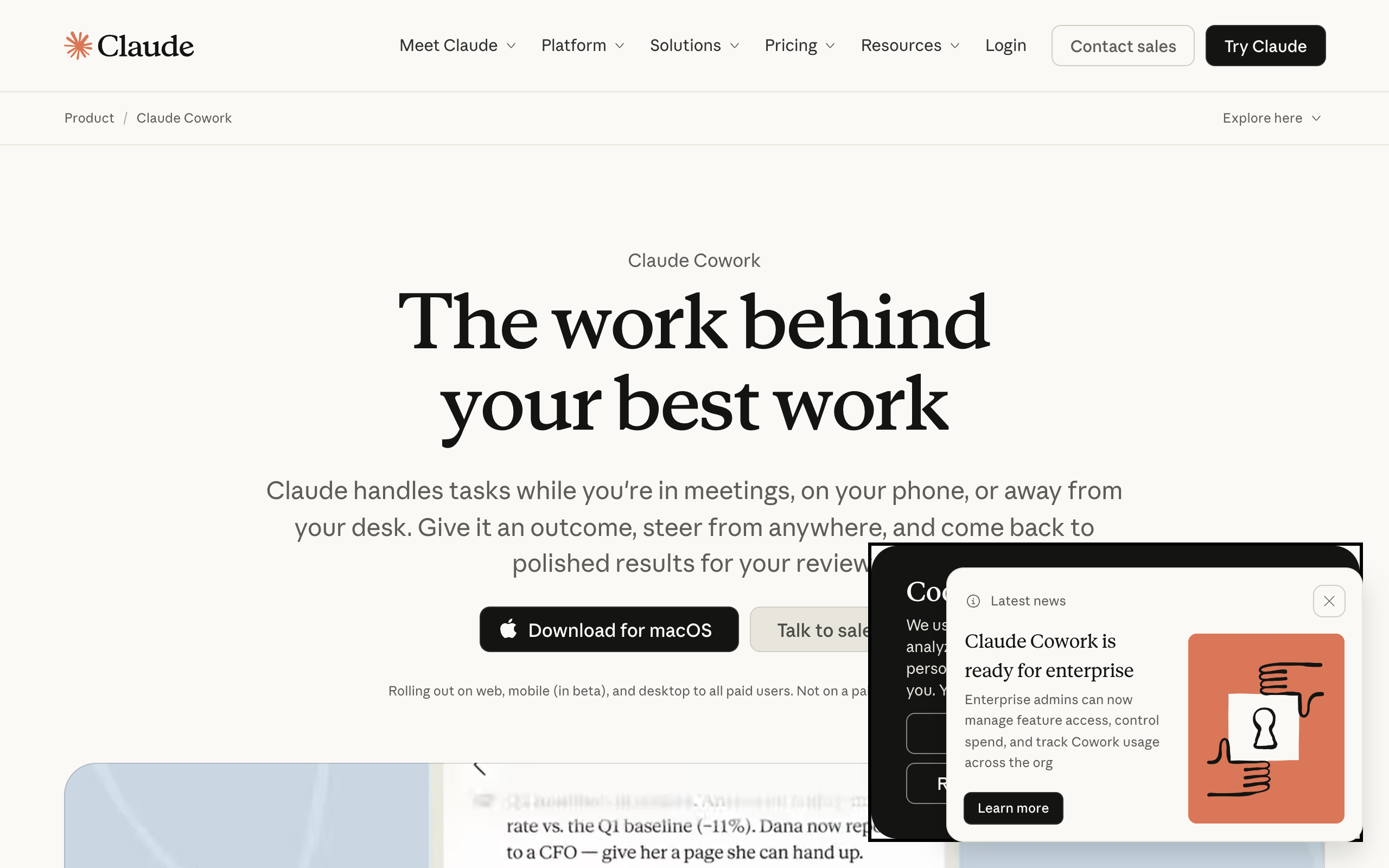
Claude Cowork brings Claude Code's agentic architecture to non-coders: describe an outcome, step away, and come back to finished work across connected files, calendar, email, and the web. Since July 7, 2026 it follows the user across desktop, web, and mobile, runs sessions remotely on Anthropic's servers, and executes background and scheduled tasks with no device online.
The scope is the session, by Anthropic's own documentation:
- Sandboxes are disposable. Each remote session's environment is "created when the session starts and destroyed when it ends".
- Sessions are personal. There is no session sharing between users; on Team and Enterprise plans, access is org-wide all-or-nothing.
- Memory is partial. Chat memory "doesn't carry into Cowork sessions yet"; memory is supported in projects only.
- Parallelism lives inside one session. Cowork coordinates multiple workstreams under ONE Claude; there are no named persistent agents, and everything draws from one person's usage windows.
For turning a described outcome into a deliverable, session scope is the right design. For operations, it is the exact gap.
The work that outlives every session
The work that outlives every session is the recurring kind: support answered within the hour, the content calendar fed weekly, invoices chased on their dates, competitors watched, reports delivered to the same people every Monday. These lanes do not want to be described again each morning; they want standing owners.
Run lanes through session tools and the human becomes the scheduler: re-describing context, re-connecting sources, ferrying one session's output into the next session's prompt. Cowork's scheduled tasks automate the trigger but not the team: each run is still one Claude, alone, starting from what the project holds, billed to one person's quota.
What to look for in the layer above sessions
The layer above sessions earns its place by holding what sessions cannot. Five criteria, in priority order:
- Persistent named agents. The same specialists, with their memory, exist next month without re-briefing.
- One durable backlog. A task board every agent and the founder read and write, with claiming, threads, and history.
- Agent-to-agent handoffs. Mentions, schedules, and inbound email wake the right agent directly; outputs become the next agent's inputs without a human ferry.
- Squad-wide cost attribution. Per-run cost, model, and trigger, on the squad's own subscription rather than a personal quota.
- A shareable live view. A co-founder or operator can watch without being handed your Claude login.
What a mission control adds to Cowork
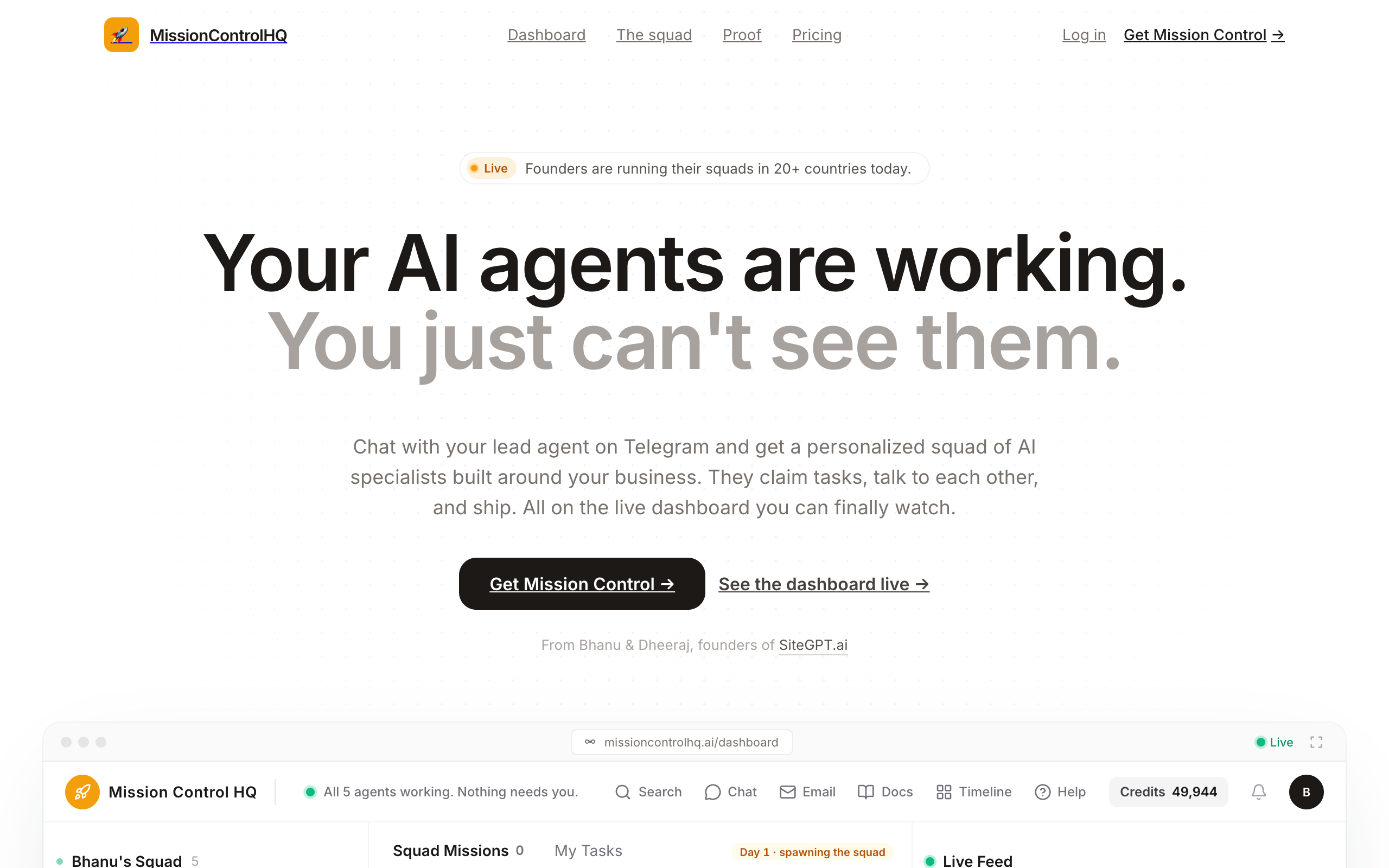
MissionControlHQ is a hosted mission control built against those five criteria:
- Named specialists that persist. The squad is designed in a conversation with a lead agent in the dashboard chat; the same agents, with their memory, exist next month.
- One shared task database. Agents claim tasks off a board, discuss them in threads, and archive them with full history, on the same board the founder watches.
- Mentions that wake agents. An @-mention in squad chat triggers the mentioned agent's run; so do cron schedules and inbound email (agent inboxes are a paid add-on).
- Founder-grade visibility. An activity feed across every agent, a runs ledger with per-run cost, model, and trigger, and a live read-only share link.
- Its own subscription underneath. The squad runs on a connected flat-rate plan, so personal Claude windows stay reserved for your own Cowork sessions.
They compose cleanly: Cowork for personal describe-an-outcome work on your Claude plan, the squad for the lanes. The full landscape comparison covers all seven tools; siblings of this guide cover Claude Code, ChatGPT Work, Codex, OpenClaw, and Hermes Agent.
What the squad stack costs
With published prices as of August 2026, pre-calculated:
- Cowork: included in paid Claude plans (pricing); heavy agentic use realistically means the Max tiers at $100-200/mo, drawn from your personal five-hour and weekly windows.
- MissionControlHQ: $99/mo flat plus the flat-rate AI plan the squad runs on, with the $100-200 tiers recommended (a $20 plan's limits run out almost immediately under squad workloads). Typical all-in: $199-299/mo, no token markup, no per-agent seats.
- The honest comparison is not plan-vs-plan but the alternative way to run continuous lanes: a junior ops/marketing hire at roughly $4,000/mo.
~94% less than one junior hire
A full squad at $199-299/mo all-in ($99 + a $100-200 flat AI plan) vs ~$4,000/mo for a single junior ops hire: roughly $44,000-45,600 saved per year, with your personal Claude quota untouched.
How to choose
What shape is the work?
- If one outcome you can describe today→Claude Cowork
- If a scheduled solo chore from your files→Cowork scheduled tasks
- If recurring lanes owned by specialists→MissionControlHQ squad
Who needs to see or touch the work?
- If just you→Cowork (sessions are personal by design)
- If a co-founder, an operator, or the public→MissionControlHQ's shared board + live share link
Whose quota should agent work drain?
- If your Claude windows have room→stay inside Cowork
- If the squad needs its own subscription→MissionControlHQ with a dedicated $100-200 flat plan
Use-case cheat sheet
| Scenario | Best pick | Why |
|---|---|---|
| Turn a messy folder into a board deck tonight | Claude Cowork | Describe-an-outcome sessions are exactly its design. |
| Weekly personal report compiled from your own files | Cowork scheduled tasks | Solo, recurring, from your account's files: its scheduled sweet spot. |
| Support inbox answered hourly, forever | MissionControlHQ | Email-triggered agent wakes; no session to describe, no personal quota drained. |
| Research → draft → publish relay without you in the middle | MissionControlHQ | Mentions hand work agent-to-agent; Cowork workstreams live and die inside one session. |
| A co-founder wants to watch the agents work | MissionControlHQ | Live share link; Cowork has no session sharing between users. |
| Deep personal research with your connected apps | Claude Cowork | Connected files, calendar, and email under your own login. |
When Cowork alone is the right answer
Cowork alone is the right answer when the work is genuinely session-shaped:
- Each job is a describable outcome: a document, a cleanup, a synthesis.
- The work is personal: your files, your calendar, your login, no other viewer.
- Scheduled tasks cover your recurring solo chores, and your Claude plan's windows have room for them.
Session tools for session work, a squad for the lanes. Most founders end up with both, and they compose: Cowork ships your deliverables while the squad runs the business around them.
Frequently asked questions
Session mechanics
Does Claude Cowork keep state between sessions? Sessions and files sync to your Claude account across desktop, web, and mobile, but each remote session's sandbox is created when the session starts and destroyed when it ends, per Anthropic's architecture notes. Chat memory does not carry into Cowork sessions yet; memory is supported in projects only.
Can a team share a Cowork session? No. Anthropic's documentation states there is no session sharing between users, and on Team plans Cowork access is org-wide all-or-nothing. Cowork is a personal agentic workspace, not a shared operations surface.
Can Cowork run scheduled work? Yes, since July 7, 2026: background and scheduled tasks run on Anthropic's servers with no device online. Each run is still a session under one Claude, drawing from one person's usage pool, without a standing multi-agent backlog between runs.
Fit and pricing
Is MissionControlHQ a Cowork replacement? No. Cowork is the best describe-an-outcome tool for non-coders on a Claude plan, and it stays that. MissionControlHQ is the layer above sessions: named specialist agents working one shared backlog with threads, schedules, per-run cost tracking, and a live dashboard, continuing between everyone's sessions.
Can I run MissionControlHQ on my Claude subscription? Yes, via Claude with Extra Usage (note it bills per token). Most founders connect a flat-rate ChatGPT plan instead, with the $100-200 tiers recommended for squad workloads. MiniMax and Z.AI also work. MissionControlHQ adds no token markup.
What does the squad cost next to Cowork? Cowork is included in paid Claude plans and draws from your personal usage windows. A MissionControlHQ squad is $99/mo flat plus the recommended $100-200 flat AI plan, so $199-299/mo all-in: roughly 93-95% less than the ~$4,000/mo junior hire the same continuous lanes would otherwise need.
What does a Cowork user actually gain from a mission control? Delegation instead of description. Cowork does what you describe, session by session, on your quota. A squad owns lanes: agents wake on schedules, mentions, and inbound email, hand work to each other, and everything lands in an activity feed and runs ledger you can share by link.
Sources
- Anthropic: Cowork product page, web + mobile announcement, architecture overview, getting started, Team/Enterprise notes, usage limits, Claude pricing
- MissionControlHQ: homepage, early access
- Related on this site: Why MissionControlHQ, Mission Control for Claude Code, Mission Control for ChatGPT Work
Last updated: August 2026. Pricing and features verified as of August 2026.