

A mission control for Codex is the layer that persists between its tasks: named agents that exist next month, one standing backlog, and a dashboard that remembers what ran and what it cost. Codex itself is built for the opposite: brilliant parallel tasks in disposable containers, reset by design, by OpenAI's own documentation.
12 hours
is the maximum lifetime of cached Codex cloud-container state between tasks: every environment is fresh-or-nearly-fresh by design, per OpenAI's documentation.
Source: OpenAI, Codex cloud environmentsiShort answer
Codex is the best way to run many coding tasks in parallel: CLI, IDE, cloud, and app, included in every ChatGPT plan. It is task-scoped on purpose: subagents don't persist, containers reset within hours, agents never message each other, and automations need your machine on. Running continuous business lanes needs the opposite shape, and that is MissionControlHQ: a persistent squad on a shared board, $99/mo flat plus the flat-rate AI plan it runs on, while Codex stays your coding tool.
Key takeaways
| Question | Short answer |
|---|---|
| Do Codex subagents persist? | No: per-session, hierarchy-only, no peer messaging, 30-min cap |
| Do cloud tasks share state? | No: per-task containers, state cached at most 12 hours |
| Do automations run unattended? | Locally only with the machine on and the app running |
| What persists in a squad? | Task board, threads, memory, schedules, cost history, for months |
| Do they compete? | No: Codex ships the code, the squad runs the lanes around it |
Codex optimizes the task. A mission control owns what happens between tasks.
Codex owns the task
Parallel worktrees, cloud containers, subagent fan-out: the strongest per-task coding machinery OpenAI ships.
Everything resets after it
Subagents end with the session, containers cache 12 hours, no agent ever messages another.
Business lanes never reset
Leads, content, support, follow-ups: continuous work that needs standing owners and schedules.
The squad layer holds it
MissionControlHQ: named agents, shared task board, mention-driven handoffs, live dashboard.
What Codex is, and what it is scoped to
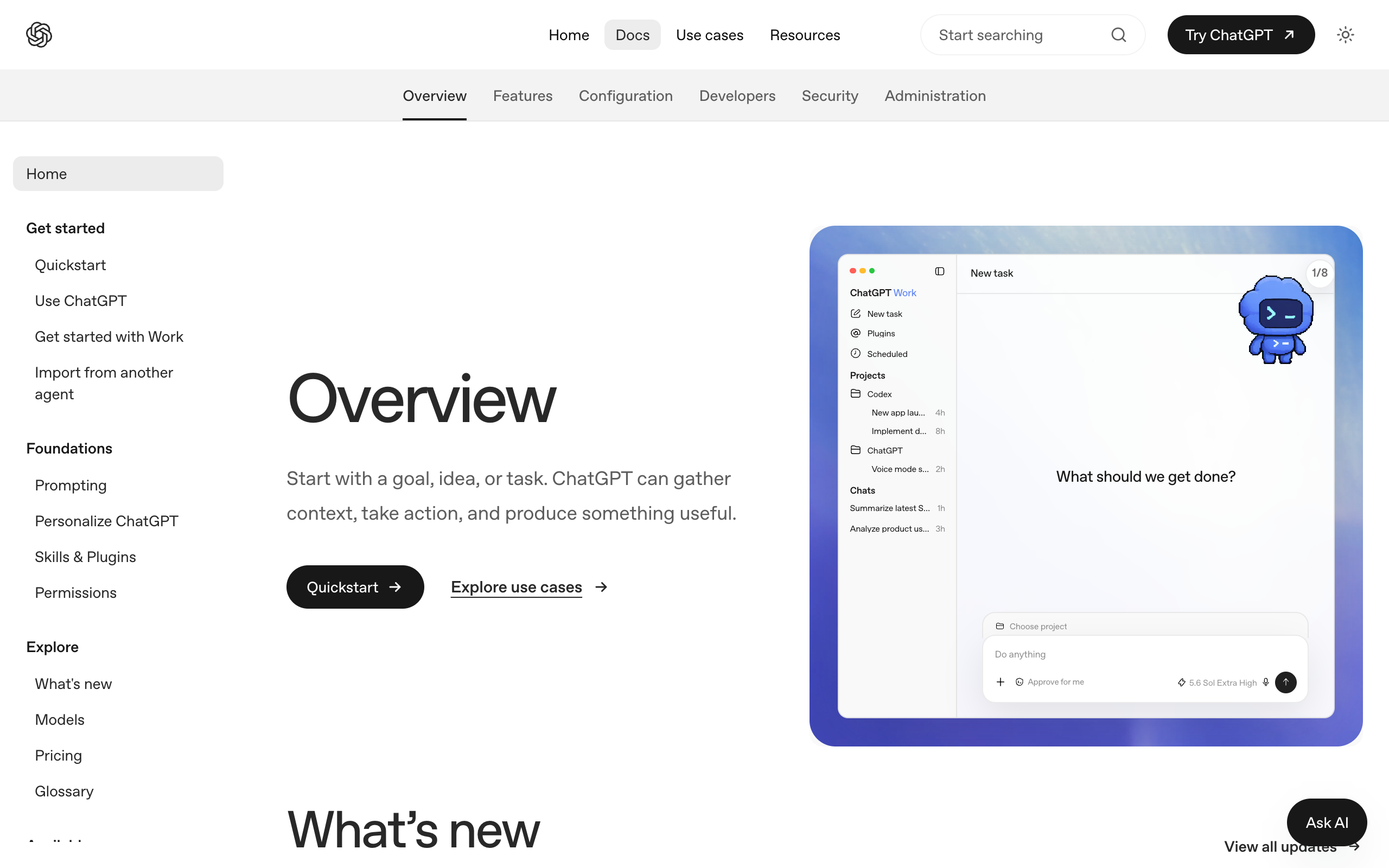
Codex is OpenAI's agentic software-engineering tool: a CLI (open source, 67,000+ GitHub stars), IDE extensions, a desktop app, cloud tasks, and GitHub code review, included in every ChatGPT plan and billed from a shared credit pool with five-hour rate windows (pricing). Its signature move is parallelism: multiple agents in isolated git worktrees locally, parallel tasks in cloud containers remotely.
The scope is the task, by OpenAI's own documentation:
- Subagents ship with built-in roles and custom TOML roles, but they "don't persist across sessions", communicate strictly parent-to-child with no peer-to-peer messaging, and default to 6 threads at depth 1 with a 30-minute runtime cap.
- Cloud tasks each get their own container; cached state between tasks lasts at most 12 hours. There is no standing environment a team of agents inhabits.
- Memories (an April 2026 preview) store auto-summaries locally; AGENTS.md carries static instructions. Neither is a shared, living task state.
- Automations schedule prompts with cron/RRULE, but local scheduled tasks require the computer on and the app running, and cannot be managed from the CLI or IDE.
For shipping code, task scope is the right design. For operations, it is the exact gap.
The work that doesn't fit in a task
The work that doesn't fit in a task is continuous: qualify yesterday's leads every morning, keep the content calendar fed, answer support within the hour, chase invoices, watch competitors weekly. These lanes have no natural task boundary. They need a standing backlog several agents read and write for months, handoffs where one agent's output wakes the next agent, schedules that survive a closed laptop, and an audit trail of what ran and what it cost.
Codex can execute any single step of those lanes brilliantly. What it cannot do, by design, is BE the lane: the container resets, the subagents dissolve, and nothing wakes tomorrow morning unless a human (or a machine that stays on) fires the prompt again.
What to look for in the layer above the task
The layer above the task earns its place by holding what tasks cannot. Five criteria, in priority order:
- Persistent named agents. The same specialists, with their memory, exist next month without being reassembled per task.
- One durable backlog. A task board every agent and the founder read and write, with claiming, threads, and history.
- Event-driven handoffs. Mentions, schedules, and inbound email wake the right agent directly, agent to agent.
- Squad-wide cost attribution. Per-run cost, model, and trigger, visible per agent and per week, without draining one person's credit windows.
- A shareable live view. The business's agent activity visible to a co-founder without a terminal.
What a mission control adds to Codex
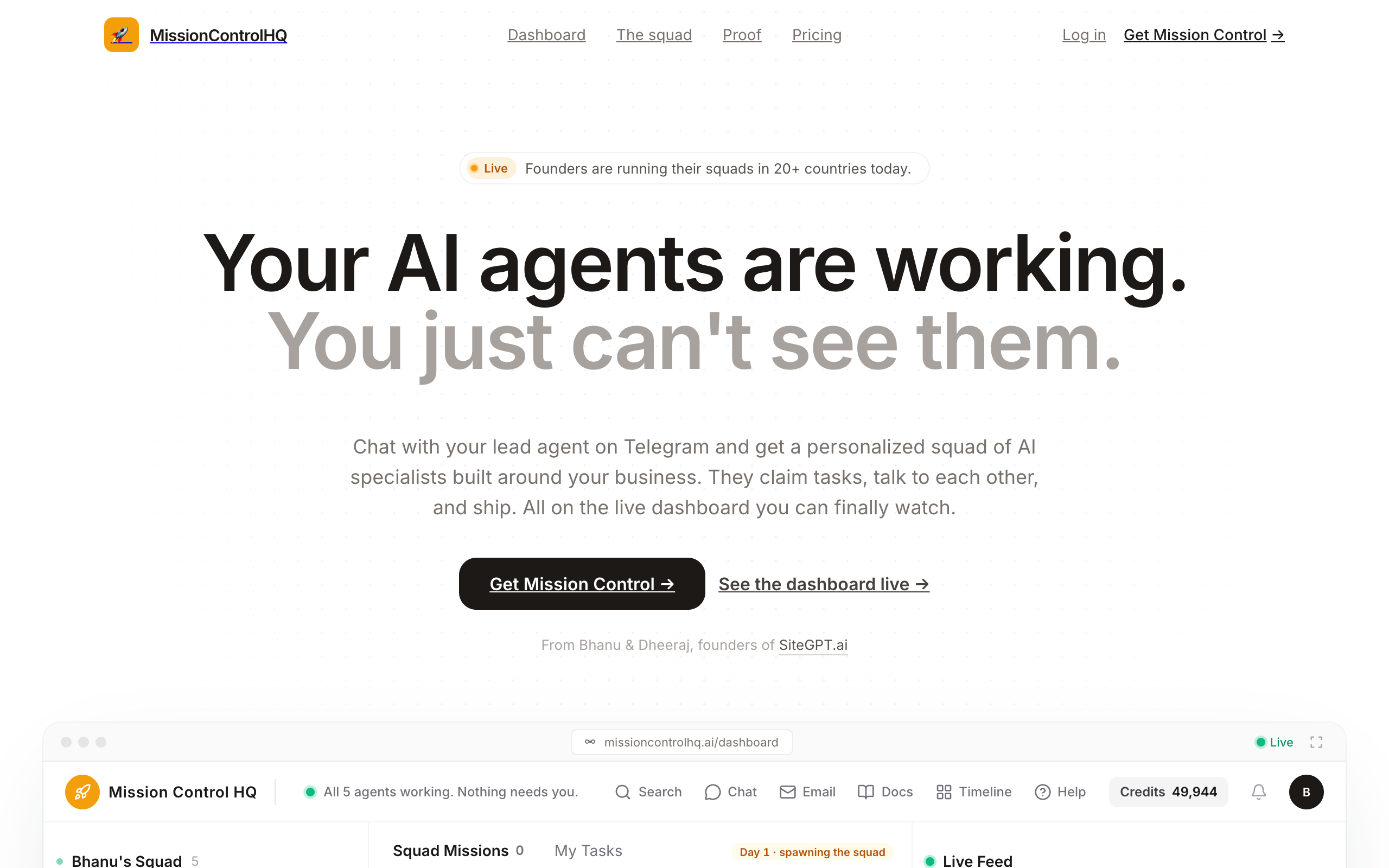
MissionControlHQ is a hosted mission control built against those five criteria:
- Named specialists that persist. The squad is designed in a conversation with a lead agent in the dashboard chat; the same agents exist next month, with their memory intact.
- One shared task database. Agents claim tasks off a board, discuss them in threads, and archive them with full history, on the same board the founder watches.
- Mentions that wake agents. An @-mention in squad chat triggers the mentioned agent's run. So do cron schedules and inbound email (agent inboxes are a paid add-on). No parent-child hierarchy, no human router.
- Founder-grade visibility. An activity feed across every agent, a runs ledger with per-run cost, model, and trigger, and a live read-only share link.
- Its own subscription underneath. The squad runs on a connected flat-rate plan, so Codex credit windows stay reserved for coding.
Codex stays in the toolbelt for what it is best at; the squad runs the lanes around it. The full landscape comparison covers Claude Code, Cowork, ChatGPT Work, OpenClaw, Hermes, and Nous Portal; there are also dedicated guides for Claude Code, OpenClaw, Claude Cowork, ChatGPT Work, and Hermes Agent.
What the squad stack costs
Codex itself is included in ChatGPT plans, billed in credits from a shared pool. The squad stack, priced honestly with August 2026 published prices:
- MissionControlHQ: $99/mo flat, no token markup, no per-agent seats.
- The AI plan it runs on: a flat-rate ChatGPT plan, with the $100-200 tiers recommended for squad workloads (a $20 plan's limits run out almost immediately when nine agents share it). Claude with Extra Usage, MiniMax, and Z.AI also work.
- Typical all-in: $199-299/mo. The honest comparison is not another AI plan but the alternative way to run continuous lanes: a junior ops/marketing hire at roughly $4,000/mo.
~94% less than one junior hire
A full squad at $199-299/mo all-in ($99 + a $100-200 flat AI plan) vs ~$4,000/mo for a single junior ops hire: roughly $44,000-45,600 saved per year.
How to choose
What shape is the work?
- If a coding task, parallel or single, with you around→Codex (CLI, cloud tasks, subagents)
- If a repo chore on a schedule, machine stays on→Codex Automations
- If continuous business lanes owned by specialists→MissionControlHQ squad
Whose budget should agent work drain?
- If your ChatGPT credit windows are fine for it→stay inside Codex
- If the squad needs its own subscription→MissionControlHQ with a dedicated $100-200 flat plan
Who needs to see what ran?
- If just you, per task→Codex task logs and diffs
- If you across weeks, or a co-founder→MissionControlHQ's feed, runs ledger, and share link
Use-case cheat sheet
| Scenario | Best pick | Why |
|---|---|---|
| Ship a feature across three repos this afternoon | Codex | Parallel worktrees and cloud tasks are exactly this shape. |
| Nightly dependency bumps on a workstation that stays on | Codex Automations | Repo-scoped, scheduled, machine-bound: their sweet spot. |
| Support inbox answered hourly, forever | MissionControlHQ | Email-triggered and scheduled runs need no open session or powered-on laptop. |
| Research → draft → publish relay across agents | MissionControlHQ | Peer-to-peer mentions move work; Codex subagents cannot message each other. |
| Know the month's agent spend per business lane | MissionControlHQ | Runs ledger attributes cost per run, agent, and trigger; Codex analytics are enterprise-gated. |
| Deep one-off refactor with review | Codex | Purpose-built coding machinery beats any dashboard for this. |
When Codex alone is the right answer
Codex alone is the right answer when the work is genuinely task-shaped:
- The agent work is all coding, in repos, reviewed as diffs.
- Parallel cloud tasks cover the fan-out (many tasks at once beats many agents that persist).
- A workstation that stays on makes local automations viable for the repo chores that need schedules.
Task tools for task work, a squad for the lanes. Most founders end up with both, and they compose: Codex ships the product while the squad runs the business around it.
Frequently asked questions
Task mechanics
Do Codex subagents persist between sessions? No. OpenAI's documentation states subagents don't persist across sessions, they communicate strictly parent-to-child with no peer-to-peer messaging, and they default to a cap of 6 threads at depth 1 with a 30-minute runtime limit.
Can Codex cloud tasks act as a standing team? No. Each cloud task runs in its own container, and cached container state lasts at most 12 hours between tasks. Codex is built for parallel, disposable work: brilliant per task, reset by design.
What about Codex Automations for scheduled work? Local scheduled automations require the computer on and the Codex app running, and they cannot be managed from the CLI or IDE. They are useful for repo chores on a workstation, not for always-on business operations.
Fit and pricing
Is MissionControlHQ a Codex replacement? No. Codex stays the coding tool; it is one of the best available. MissionControlHQ is the layer above the task: a persistent squad of named agents working a shared backlog with threads, schedules, per-run cost tracking, and a live dashboard, continuing while no Codex session is open.
Can I run MissionControlHQ on my ChatGPT subscription? Yes. Most founders connect a flat-rate ChatGPT plan, with the $100-200 tiers recommended for squad workloads (a $20 plan's limits run out almost immediately). Claude with Extra Usage, MiniMax, and Z.AI also work. MissionControlHQ adds no token markup.
What does the squad stack cost next to Codex? Codex is included in ChatGPT plans and billed from a shared credit pool. A MissionControlHQ squad costs $99/mo flat plus the recommended $100-200 AI plan, so $199-299/mo all-in: roughly 93-95% less than the ~$4,000/mo junior hire the same continuous lanes would otherwise need.
What does a Codex user actually gain from a mission control? Continuity and visibility between tasks. A backlog that exists when no session is open, agents that wake each other with @-mentions instead of waiting for a prompt, per-run cost attribution across the squad, and a live shareable dashboard of everything that ran.
Sources
- OpenAI: Codex overview, subagents docs, cloud environments, automations, pricing, Codex GitHub repo, ChatGPT pricing
- MissionControlHQ: homepage, early access
- Related on this site: Why MissionControlHQ, Mission Control for Claude Code, Mission Control for OpenClaw
Last updated: August 2026. Pricing and features verified as of August 2026.